Table of Contents
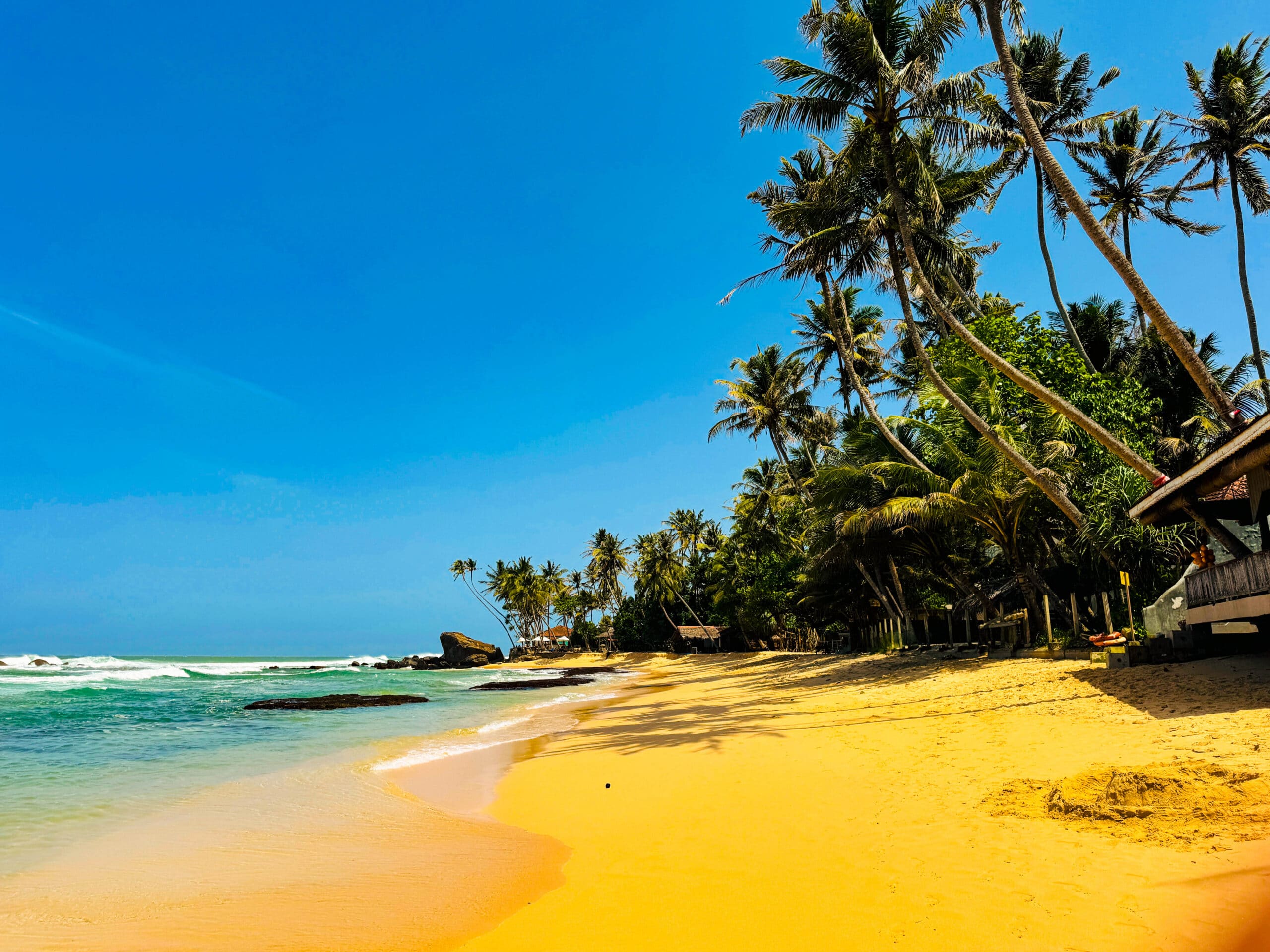
Sri Lanka doesn’t have one beach season — it has two. And that single fact changes everything about how you plan your trip. The island sits at the crossroads of two opposing monsoon systems, which means that while one coast is drenched in rain, the other is bathed in sunshine. Get the timing right, and you’ll find some of the most beautiful stretches of sand in Asia. Get it wrong, and you’ll be sheltering under a beach shack watching the waves roll over your plans.
We’ve explored parts of this coastline ourselves — including Unawatuna, where we stumbled on one of Sri Lanka’s best-kept morning secrets — and researched the rest thoroughly. What follows is an honest guide to the best beaches in Sri Lanka, organised by coast and season, so you can find exactly what you’re looking for — whether that’s a surf break, a quiet cove, a family-friendly lagoon, the best spot to see sea turtles up close, or a stretch of sand you’ll have almost entirely to yourself.
In a Rush?
These are my Favourite Beach Hotels in Sri Lanka
⭐️⭐️⭐️ The Six Weligama – Check prices and availability
⭐️⭐️ Nisala Villas Mirissa – Check prices and availability
⭐️ Rockside Cabanas Unawatuna – Check prices and availability
The Best Beaches in Sri Lanka at a Glance
Sri Lanka’s beach landscape splits neatly along two axes: coast and season. Use this table to find what fits your trip.
| Beach | Coast | Best months | Best for | Vibe |
|---|---|---|---|---|
| Unawatuna | South | Nov–Apr | Families, swimming, turtles | Lively, accessible |
| Dalawella / Wijaya Beach | South | Nov–Apr | Families, calm water, turtles | Quiet, reef-protected |
| Weligama | South | Nov–Apr | Beginner surfers, families | Buzzy, surf-school central |
| Mirissa | South | Nov–Apr | Whale watching, sunsets | Social, postcard-pretty |
| Hiriketiya | South | Nov–Apr | Intermediate surfers, yogis | Bohemian, trending |
| Ahangama | South | Nov–Apr | Intermediate surfers, foodies | Chill-cool, hip |
| Tangalle | South | Nov–Apr | Seclusion, beach walks | Remote, wild |
| Arugam Bay | East | May–Oct | Advanced surfers, free spirits | Laid-back, legendary |
| Uppuveli | East | May–Oct | Swimming, sunrises | Relaxed, local feel |
| Nilaveli | East | May–Oct | Snorkelling, seclusion | Empty, pristine |
| Passikudah | East | May–Oct | Families, calm water | Resort-style, sheltered |
Understanding Sri Lanka’s Two Coasts
Before diving into specific beaches, there’s one thing every traveller needs to understand: Sri Lanka’s weather is shaped by two distinct monsoon seasons that affect completely different parts of the island.
The southwest monsoon (locally called Yala) typically hits the south and west coasts between roughly May and September, bringing heavier rainfall and rougher seas to beaches like Unawatuna, Mirissa, and Weligama. The northeast monsoon (Maha) does the opposite — rolling in from November to January and affecting the east coast around Trincomalee and Arugam Bay.
In practice, the rule of thumb is: south coast from November to April, east coast from May to early October. But here’s the thing — Sri Lanka’s weather doesn’t always read the script. Climate patterns have become increasingly unpredictable, and we’ve personally had brilliant sunny days in Unawatuna during what’s technically the monsoon season. We’ve heard from plenty of travellers who’ve done the same. The “wrong” season often still delivers patches of gorgeous weather, particularly in the shoulder months.
The takeaway: use the seasons as a guide, not a dealbreaker. Check forecasts close to your travel date (we use Accuweather), keep some flexibility in your itinerary, and don’t let the calendar alone talk you out of a trip. A rainy morning on the south coast typically still has warm evenings — and far fewer crowds.
For the full breakdown of what to expect each month, our Sri Lanka monsoon guide and weather by month series cover the details.
The South Coast: Sri Lanka’s Most Popular Beach Destination
Sri Lanka’s south coast is — by a wide margin — where the majority of beach tourism happens. The vast majority of travellers visiting Sri Lanka include the south coast in their route, and for good reason: it combines stunning beaches, excellent surf, great food, and a well-developed tourism infrastructure in a way the east coast simply doesn’t match yet. Even during the monsoon months, many travellers still head south and find perfectly enjoyable conditions between the showers.
The south coast runs from Hikkaduwa and Galle in the west all the way around to Tangalle in the east — a string of surf towns, quiet coves, and lively resort villages, each with its own character. If you’re a first-time visitor to Sri Lanka with limited time, this is where your beach days belong.
Hikkaduwa — Best Beach for Snorkelling & South Coast History
Best for: snorkellers, turtle encounters, those wanting a lively hub | Not ideal for: those seeking quiet or seclusion
Hikkaduwa is one of the original beach towns on Sri Lanka’s south coast and still one of the most visited. It’s a lively place with surf shops, restaurants, and a nightlife scene that kicks in after dark. The main beach — Narigama — is long and sandy, backed by a constant stream of guesthouses and beach bars.
What keeps people coming back is the snorkelling. The reef just offshore is home to an impressive variety of tropical fish, and sea turtles frequent the shallows in the northern part of the beach, just in front of the larger hotel there. They can be spotted right from the shoreline, which makes Hikkaduwa one of the easiest places in Sri Lanka to have a turtle encounter without booking any kind of tour.
Surfing at Hikkaduwa is also excellent — Main Reef offers long right-handers with both open shoulders and occasional tube sections, and there are beach peaks for beginners too. It’s busier and more localised than Weligama, but a classic for a reason.
Unawatuna — Best Overall Beach for Swimming & Turtles
Best for: families, swimming, turtle spotting | Not ideal for: those avoiding crowds
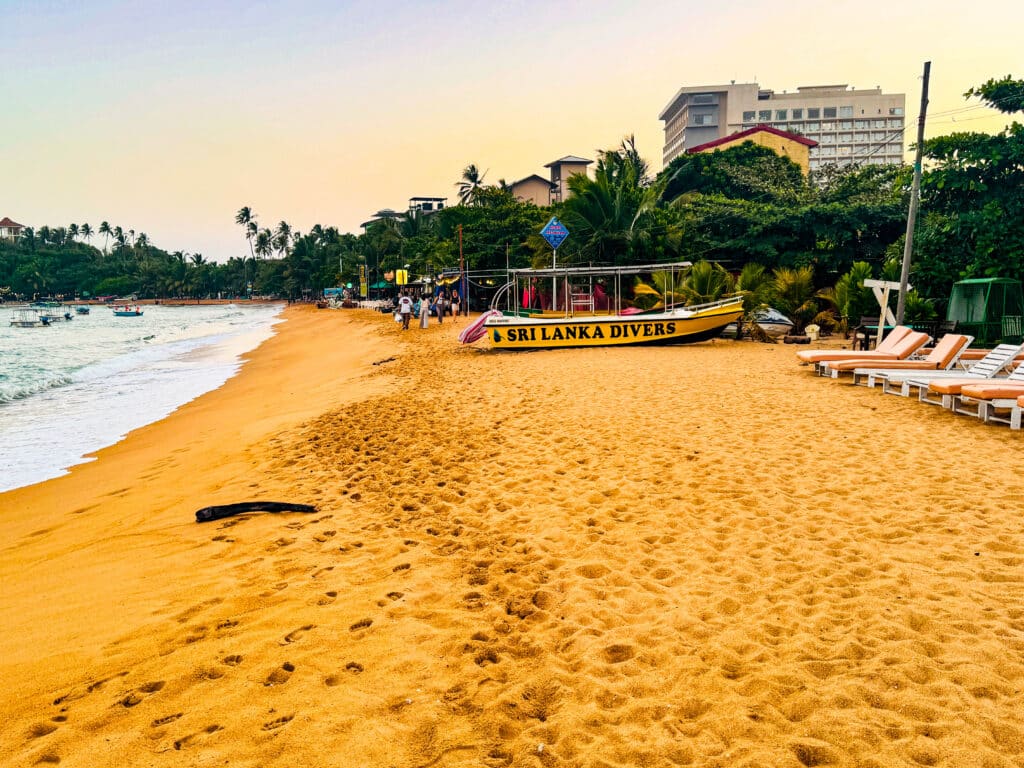
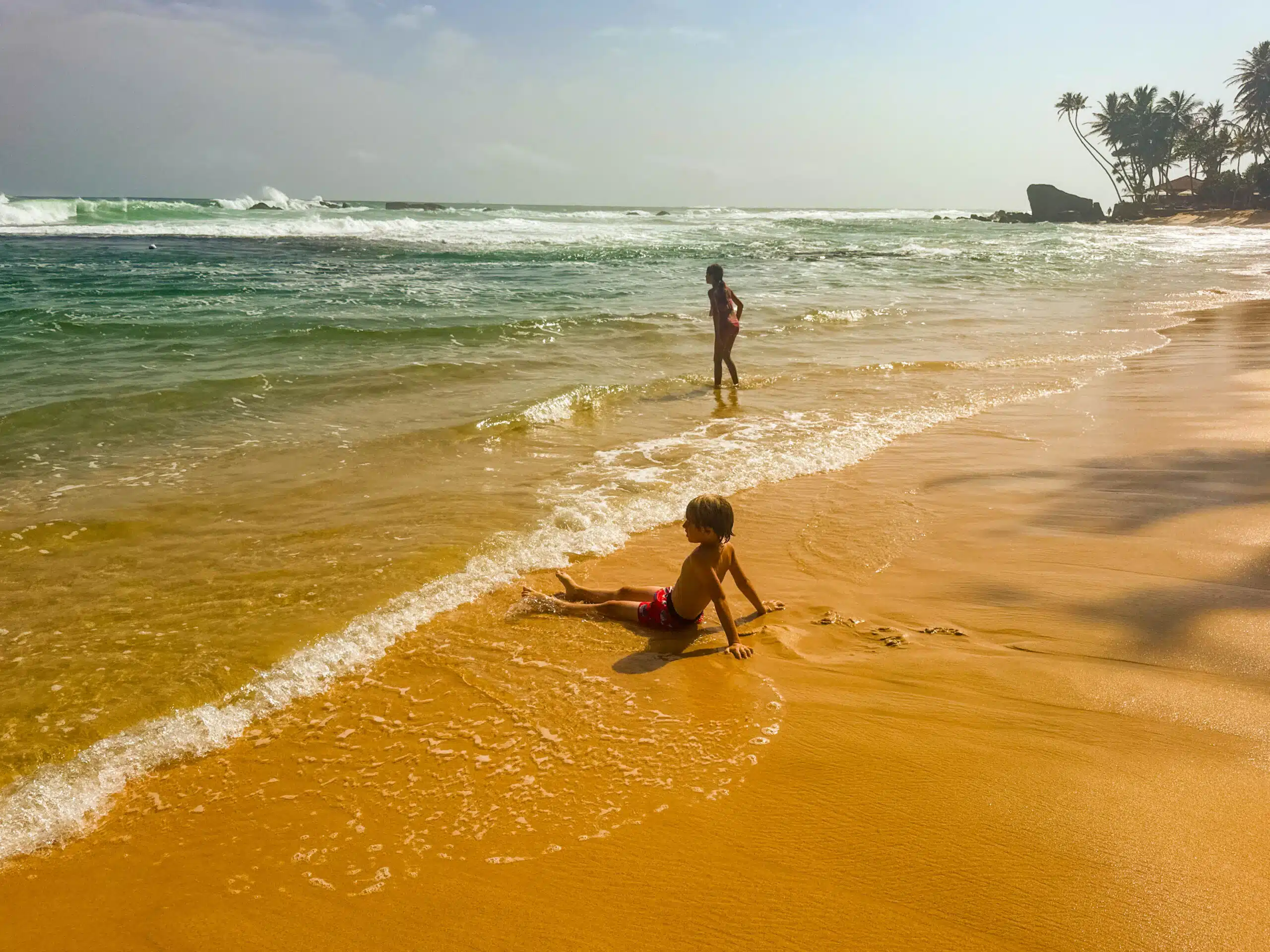
Unawatuna is a curved bay backed by a reef that keeps the water relatively calm for most of the season — and that makes it one of the best beaches in Sri Lanka for actual swimming. Unlike many of the more dramatic surf beaches further along the coast, you can genuinely get in the water here without being knocked flat.
The town has grown significantly over the past decade. There’s a whole strip of restaurants, dive shops, and beach bars along the bay, and during peak season (December to February) it gets busy. But the energy is good and it’s very well-set-up for families.
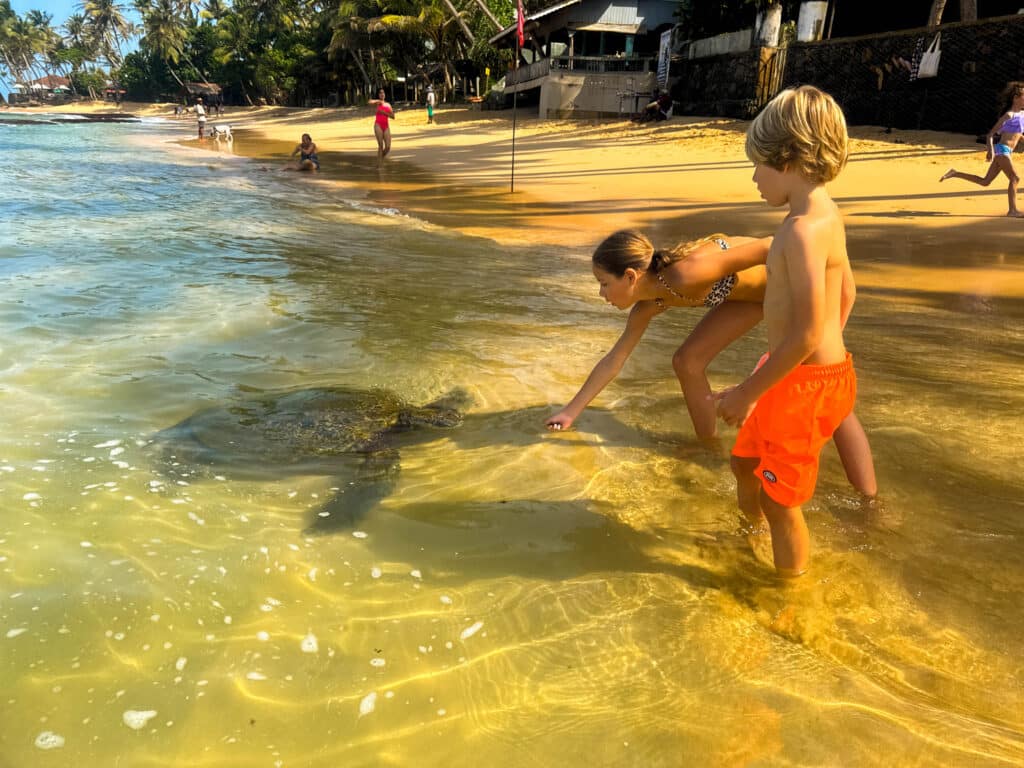
The real highlight, though, is Wijaya Beach — a short walk east of the main bay. Here a natural reef creates a protected lagoon with startlingly calm, clear water. We were there one morning and the sea turtles came right up to the shore — no snorkel needed, no boat trip required. They feed in the shallows and will approach within arm’s reach if you’re patient and calm. Aim to arrive around 8am to get the best experience before the tour groups arrive around 10am. Once the crowds build, the magic fades quickly.
A word of caution: please give the turtles space. We saw visitors trying to touch and even lift them — this is harmful and unnecessary. Stand still, let them come to you, and you’ll have a far better encounter. For everything you need to know about Unawatuna — beaches, turtles, restaurants, and where to stay — read our full Unawatuna guide.
Best for: families, calm-water swimming, turtle encounters | Not ideal for: those without direct hotel access (high tide closes the beach)
Just east of Unawatuna, Dalawella is technically a separate beach — but it merges with Wijaya Beach, which we’ve described above. The main draw here is the reef-protected lagoon, which is arguably the safest swimming spot on the entire south coast.
The beach is narrow and at high tide the water comes right up to the sea wall, so timing matters. Early mornings and late afternoons are the sweet spots. The handful of hotels here tend to have direct access through their grounds, which is why staying in the area is worth it.
A note for the Instagram crowd: there’s a famous palm tree rope swing here that’s been photographed thousands of times. It’s still there, it’s still fun, and the queue moves quickly.
Where to stay near Wijaya Beach: Rockside Cabanas — Booking.com 8.7 | $95/night BB | Right next to Wijaya Beach, with pool access and beach steps away. Good value for the location.
If you’re looking for something more upscale within easy reach, the Galle Fort area is only about 15 minutes away. Jetwing Lighthouse — Booking.com 8.9 | $770/night | sits on the cliffs between Galle and Unawatuna with direct sea views — an excellent base for exploring both.
If you want to book a guided snorkelling session in the area: Snorkelling in Unawatuna
Dalawella Beach / Wijaya Beach — Best for Families & Calm Water
Weligama — Best Beach for Learning to Surf
Best for: beginner surfers, families | Not ideal for: experienced surfers looking for challenge, those wanting a quiet beach
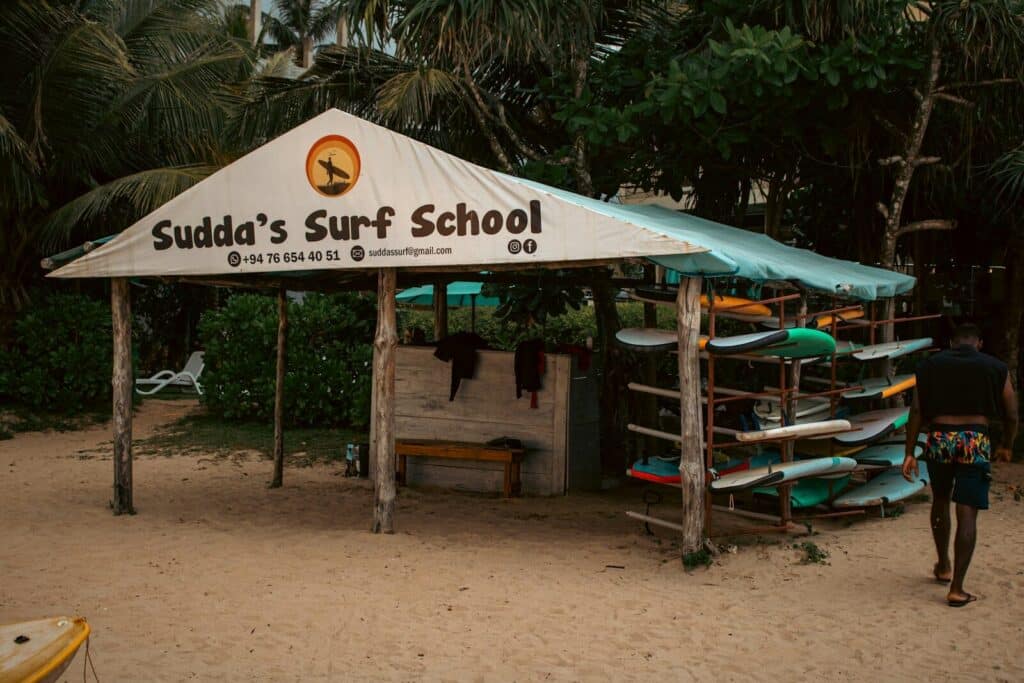
Weligama is where Sri Lanka’s surf story usually begins. The bay is wide and gentle, the waves break over sand rather than reef, and there are more surf schools per square kilometre here than almost anywhere else in the country. If you’ve never stood on a board before, this is the place.
The beach itself is long and reasonably sandy, though the western end near the fishing harbour is less appealing. Head east for the better stretches. The town has a good selection of cafés and restaurants, and the vibe is energetic without being overwhelming.
Advanced surfers tend to move on quickly — the waves here are deliberately forgiving — but as a base for a few days of learning, Weligama is hard to beat on this coast.
Where to stay in Weligama: The Six Weligama — Booking.com 9.8 | from $2,050/night BB | One of the highest-rated hotels on the entire island. Stunning clifftop setting above the bay with exceptional service and views. A splurge, but genuinely in a class of its own.
For surf lessons, we recommend booking ahead in peak season: Surf Lessons Weligama
Mirissa — Best Beach for Whale Watching & Sunsets
Best for: whale watching, couples, social evenings | Not ideal for: those avoiding noise, large groups
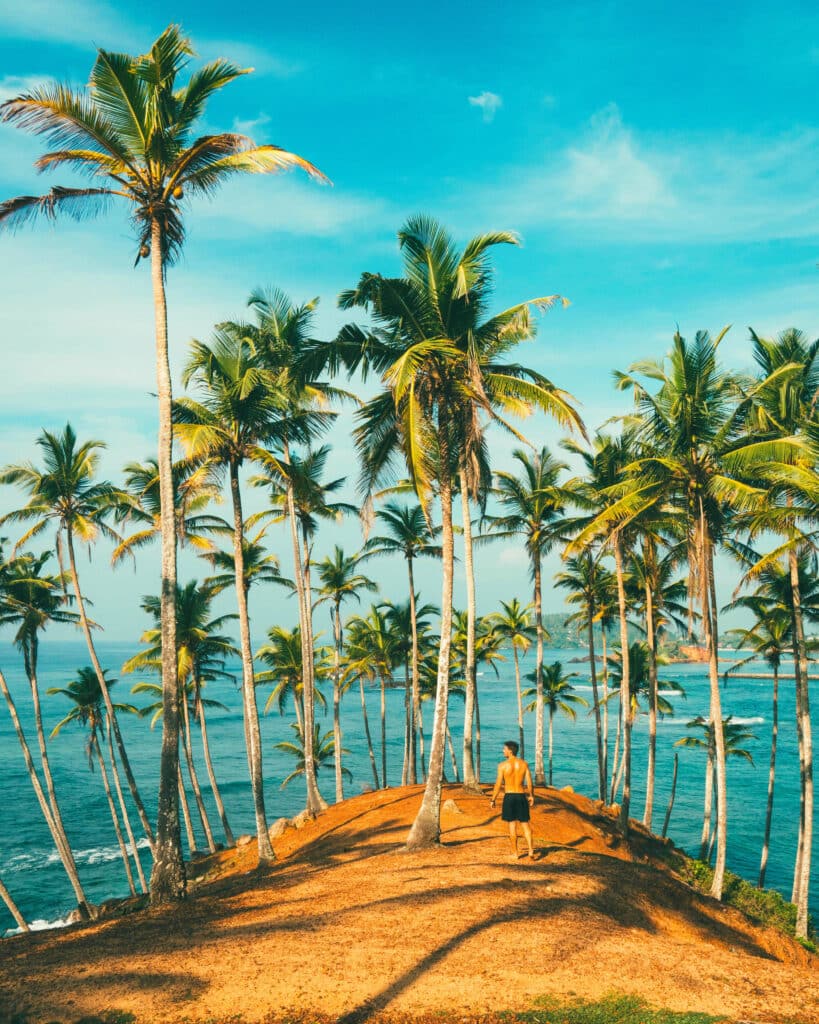
Mirissa has one of the most recognisable silhouettes on the south coast — a crescent of sand framed by palms, bookended by Parrot Rock in the middle of the bay. It’s pretty in the postcard sense, and it knows it.
The real draw here is whale watching. From November through April, blue whales gather offshore in numbers that few places on earth can match. Tours depart early morning from the harbour, and while sightings are never guaranteed, the odds are genuinely good. There’s also good snorkelling in the bay east of Parrot Rock, and a reef break on the west side that suits intermediate surfers on smaller swells.
In the evenings, Mirissa comes alive. Restaurants line the beach with candles and fairy lights, happy hours stretch until well into the evening, and the atmosphere is relaxed and social. It’s one of the livelier beach towns on the coast — if that appeals to you.
For a quieter alternative, the so-called Secret Beach is a short walk from the main bay — smaller, rockier, but dramatically beautiful at sunset.
Where to stay in Mirissa: Nisala Villas — Booking.com 9.0 | from $825/night BB | Boutique villas with high design standards and a peaceful setting a short walk from the main beach.
For whale watching: Whale Watching Mirissa
For snorkelling with turtles: Snorkelling with Turtles Mirissa
Hiriketiya — Best Beach for Atmosphere & Intermediate Surfers
Best for: intermediate surfers, yogis, digital nomads | Not ideal for: those wanting total quiet or a classic resort experience
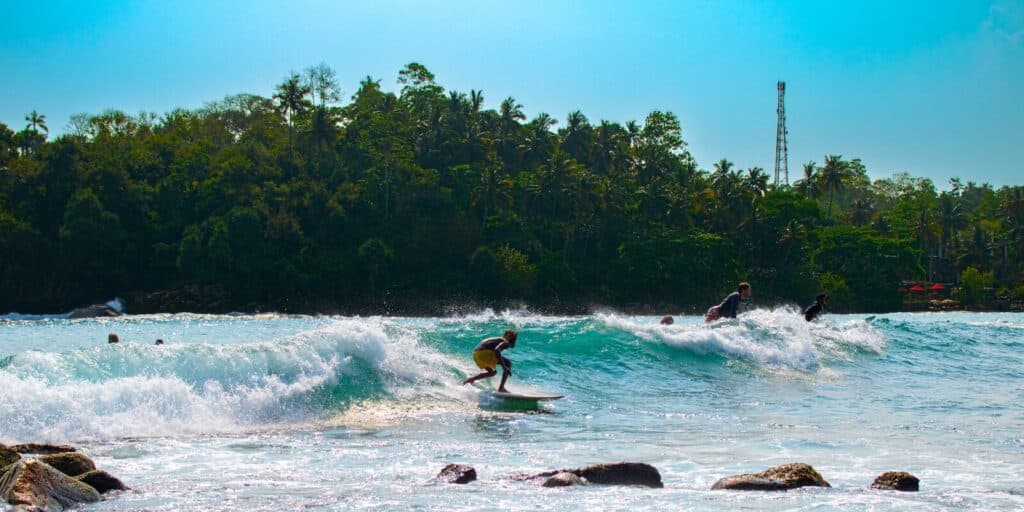
Hiriketiya has had a dramatic glow-up. Five years ago it was a word-of-mouth secret among surfers who made the long drive from Galle to find a horseshoe bay that was barely even on the map. Today it’s the south coast’s most talked-about destination, with smoothie bars, yoga shalas, boutique guesthouses, and a café scene that wouldn’t look out of place in Bali.
The beach is genuinely beautiful — a deep, protected bay with a consistent left-hand wave that works well for intermediate surfers. The inside of the bay has softer reforms for learners, though it gets crowded during peak season. The water is swimmable for most of the season thanks to the bay’s sheltered shape.
What makes Hiriketiya work beyond the surf is the overall package: the food is good, the accommodation is creative, and the crowd skews young and international. Go early in the morning before the masses arrive and you’ll understand why people first fell in love with it.
Where to stay in Hiriketiya: Gaia Soul — Booking.com 9.2 | from $120/night BB | Well-reviewed boutique stay in the heart of Hiriketiya with a pool and strong eco ethos.
Ahangama — Best Beach Area for Foodies & Surfers
Best for: intermediate surfers, food lovers, those wanting a hip but relaxed base | Not ideal for: families with young kids, swimming
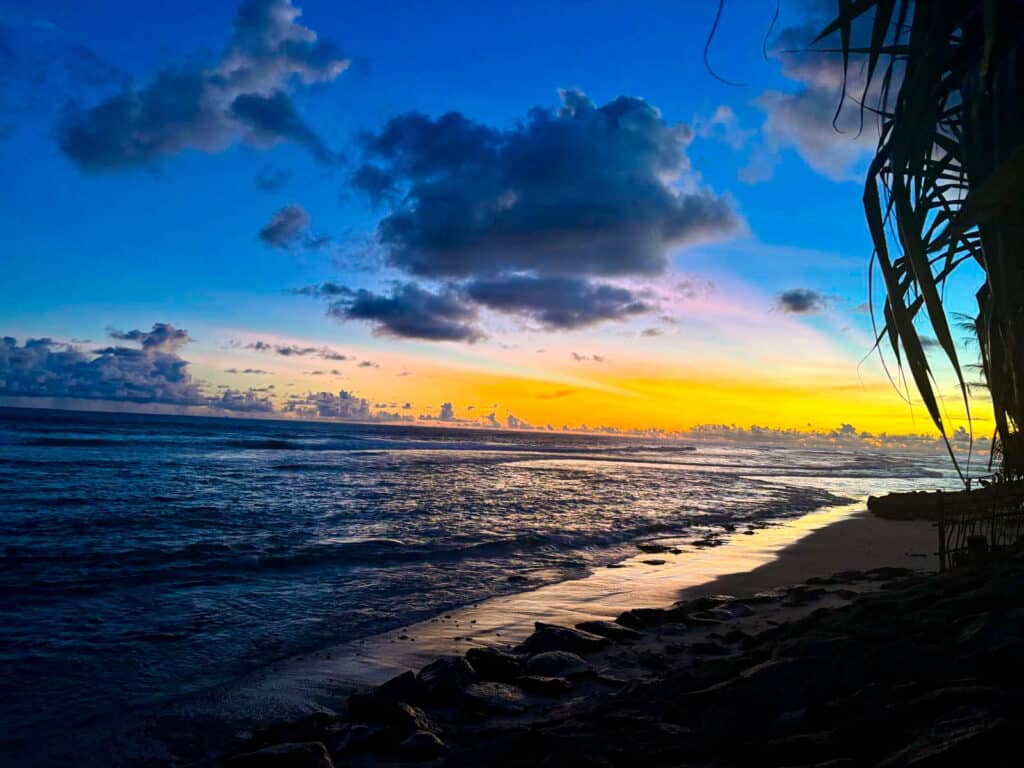
Ahangama doesn’t have one single beach so much as a string of reef-lined coves and rocky inlets along the Galle-Matara road. It’s not a classic swim-and-sunbathe spot — the reef breaks are the point. Kabalana Beach, at the northern end of the Ahangama stretch, has what’s widely considered one of Sri Lanka’s best deep-reef breaks: a fast, bowly A-frame called The Rock.
What Ahangama has done brilliantly in the past few years is build a hospitality scene that rivals Hiriketiya. Think specialty coffee, natural wine, interesting restaurants, and co-working setups. It’s the kind of place where people come for a week and end up staying for a month.
Where to stay in Ahangama: Kurulu Bay — Booking.com 9.5 | $300/night BB | One of the highest-rated properties in the area, known for its position close to the surf breaks.
Tangalle — Best Beach for Seclusion & Wild Beauty
Best for: those seeking seclusion, beach walks, nature lovers | Not ideal for: swimming (currents can be dangerous), those wanting nightlife
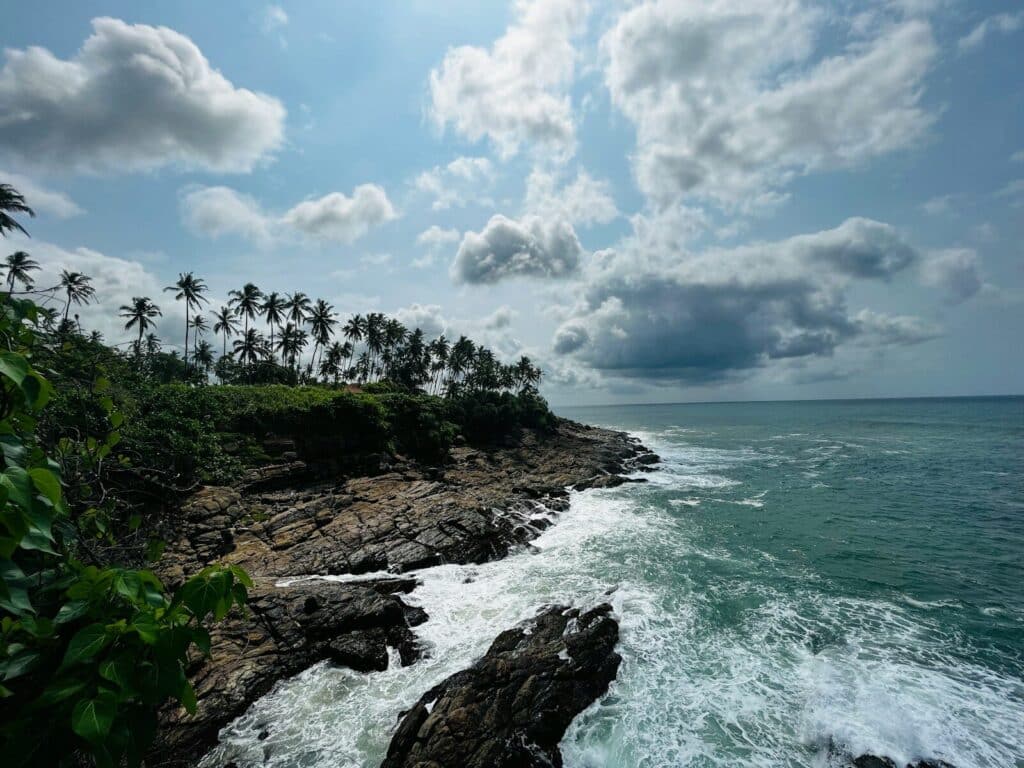
Tangalle is where the south coast gets wild. The main beach is a sweeping arc of golden sand that stretches for what feels like miles, backed by palms and dotted with the occasional fishing boat. The waves here are powerful — often too rough for swimming — so come for the scenery and the solitude rather than the water.
The area around Tangalle also has some of Sri Lanka’s best wildlife nearby: Udawalawe and Bundala national parks are within reach, and the lagoons behind the beach are home to crocodiles and birds. It’s a natural complement to a south coast beach trip rather than a standalone party destination.
Where to stay near Tangalle: Anantara Peace Haven Tangalle — Booking.com 9.3 | from $1,130/night BB | One of Sri Lanka’s most celebrated luxury resorts, set on a private headland above the sea. Worth every rupee if the budget allows.
Shangri-La Hambantota — Booking.com 8.7 | $800/night BB | A full-scale luxury resort about 40 minutes further east along the coast, with Sri Lanka’s only 18-hole golf course and direct beach access. Hambantota itself is a convenient staging point before Yala National Park.
Also Worth Knowing on the South Coast
A few more beaches that don’t need a full section but are worth flagging:
Talalla is a long, palm-fringed bay between Dickwella and Tangalle that feels almost untouched. The waves are too powerful for casual swimming, but for a morning beach walk with nothing but palms and ocean in view, it’s one of the most beautiful stretches on the coast. Several small boutique hotels are tucked behind the palms.
Polhena, just outside Matara, is a small sheltered bay protected by a reef — ideal for calm-water swimming and turtle spotting, without the infrastructure of Unawatuna. It’s a good option if you’re already in the Matara area heading east.
Koggala is a long, quiet stretch bordering the famous Koggala Lake. Less developed than the main surf towns, it suits travellers who want a peaceful base. The lake itself is worth exploring — we did the boat tour from the Galle area, sailing through mangroves and spotting birds, monitor lizards, and monkeys. An underrated activity on the south coast.
The East Coast: A Different Sri Lanka
If the south coast is Sri Lanka’s main event, the east coast is its best-kept secret. Fewer tourists, longer empty beaches, less infrastructure — and a beach season that runs exactly when the south coast is at its wettest. It’s a genuine alternative, not an equal one: most travellers who visit Sri Lanka only ever see the south coast, and they leave perfectly happy. But if your dates fall between May and October, or if you’re coming back for a second or third trip, the east coast deserves serious consideration.
Uppuveli — Best East Coast Beach for Relaxed Swimming
Best for: relaxed beach days, sunrises, low-key atmosphere | Not ideal for: advanced surfers, party seekers
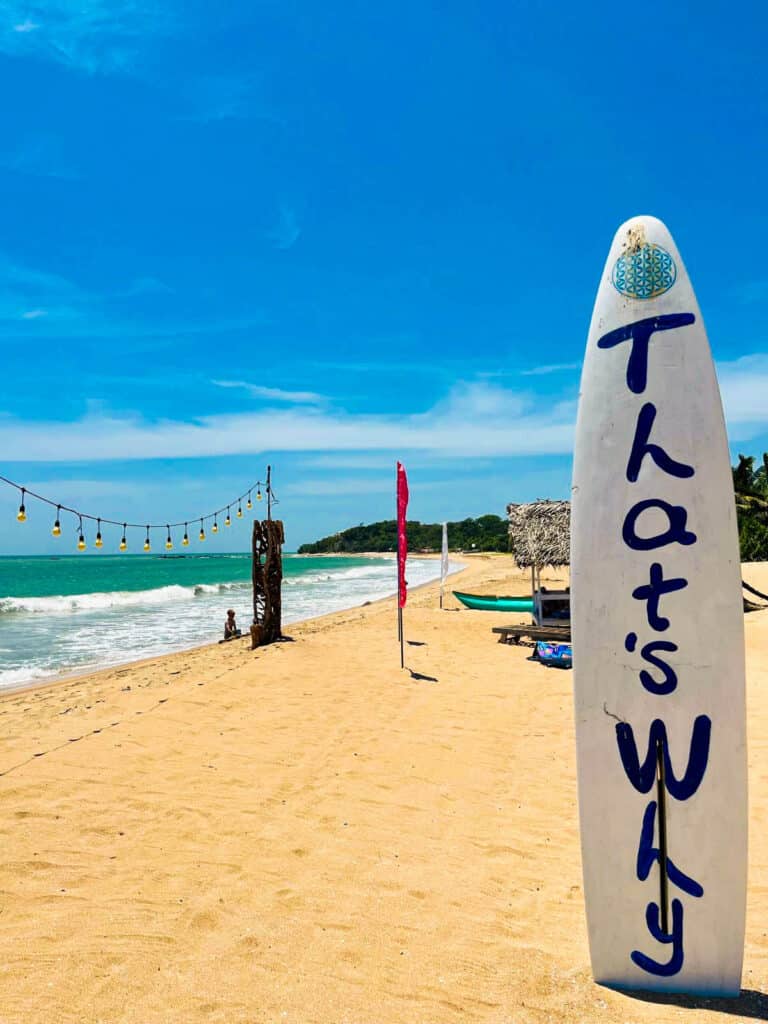
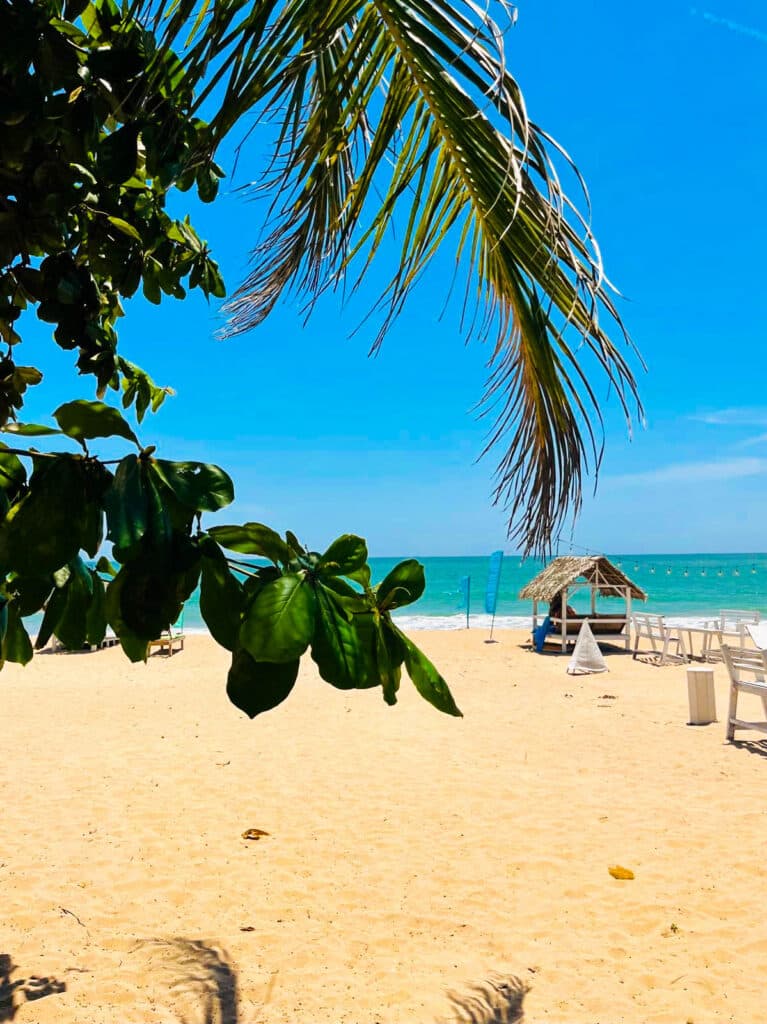
Uppuveli is the most accessible of the Trincomalee beaches, just four kilometres north of the city. It’s a long, sandy stretch with a handful of beach bars and guesthouses, calm water between May and September, and almost none of the tourist infrastructure that characterises the south coast. Sunrises here are genuinely spectacular.
The atmosphere is quiet and local. You’re more likely to share the beach with fishing boats than tour operators.
Where to stay near Uppuveli: Regina Beach Bungalow — Booking.com 9.4 | $80/night | Simple, good-value bungalows directly on the beach. Sandy Shores Trincomalee — A well-regarded option close to the beach.
For water activities from Trincomalee: Snorkelling Tour Trincomalee Whale & Dolphin Watching Trincomalee
Nilaveli — Best East Coast Beach for Seclusion & Snorkelling
Best for: snorkelling, empty beaches, Pigeon Island day trips | Not ideal for: those wanting facilities or nightlife
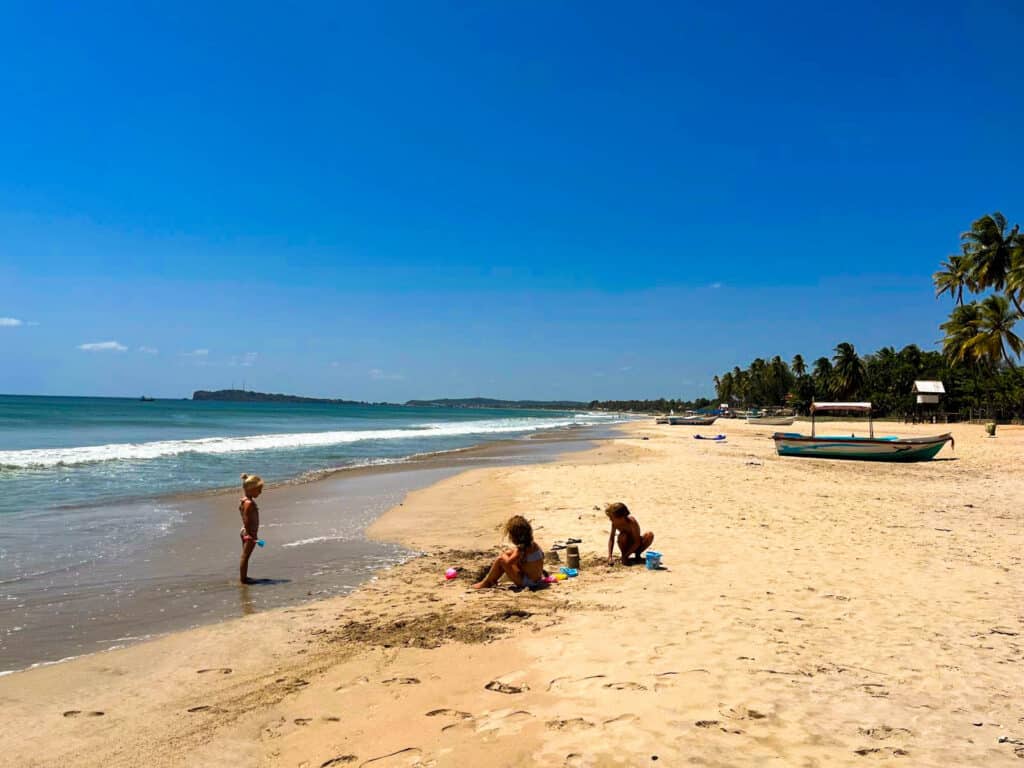
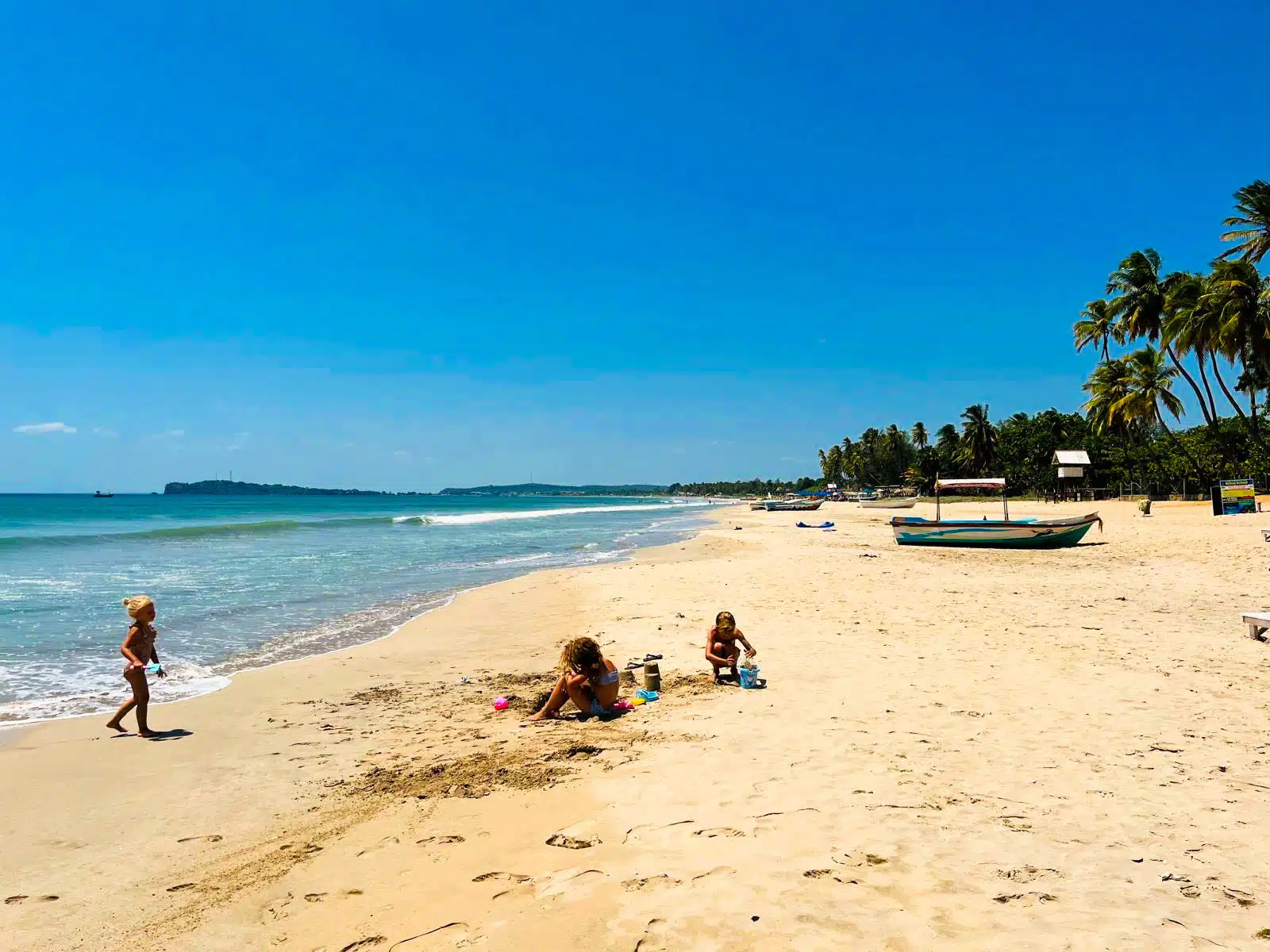
Nilaveli is nine kilometres north of Trincomalee and a step further removed from tourist infrastructure. It’s a four-kilometre stretch of wide, ivory sand with few hotels and fewer crowds. During the week, it can feel almost deserted.
The real attraction lies just offshore: Pigeon Island, a protected marine park with healthy coral and a resident population of blacktip reef sharks. It’s widely regarded as one of the best snorkelling sites in Sri Lanka, and day trips from Nilaveli can be arranged easily.
Note that swimming at Nilaveli can be treacherous outside the May–September window, when the sea shelves steeply and currents can be unpredictable. During the season, conditions are usually excellent.
Passikudah — Best East Coast Beach for Families & Calm Water
Best for: families, calm-water swimming, resort-style holidays | Not ideal for: budget travellers, those wanting local atmosphere
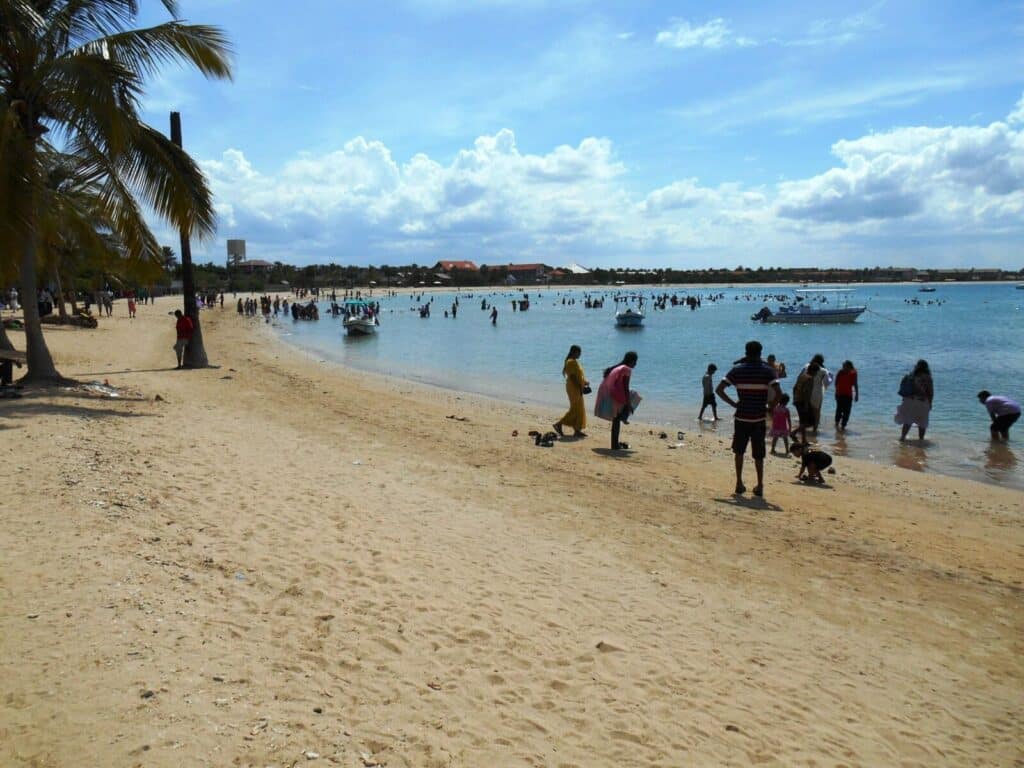
Passikudah is the east coast’s most developed beach destination — a long, shallow bay with water so calm it barely ripples. The bay is sheltered by a reef and the sea here is genuinely among the gentlest in Sri Lanka, making it ideal for children and anyone who wants to simply float without worrying about waves.
Several upmarket resorts line the bay, and the overall feel is more resort-package than backpacker-circuit.
Where to stay in Passikudah / Kalkudah: Uga Bay Passikudah — Booking.com 9.3 | $385/night BB | One of the east coast’s top boutique properties, right on the bay. Kalkudah Beach House — Booking.com 9.6 | $300/night BB | A highly rated boutique stay on the quieter Kalkudah stretch, just north of Passikudah. Sun Siyam Pasikudah — TripAdvisor 4.7/5 | $170/night HB | A more affordable option right on the bay with half-board included.
Arugam Bay — Best Beach for Surfing
Best for: experienced surfers, free spirits, off-the-beaten-track travellers | Not ideal for: families with young kids, luxury seekers
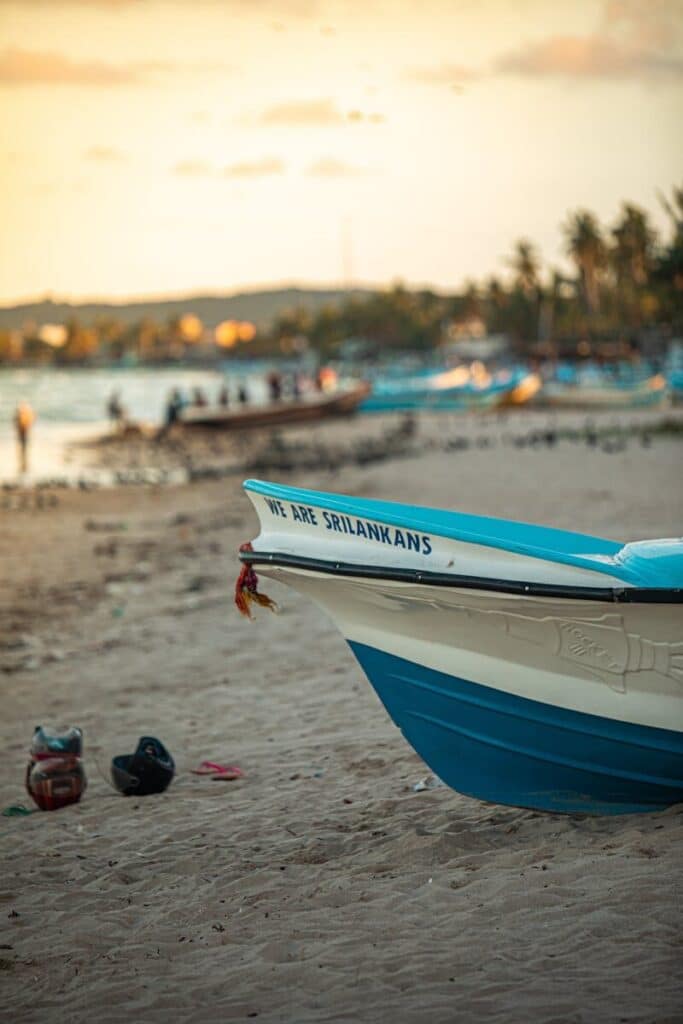
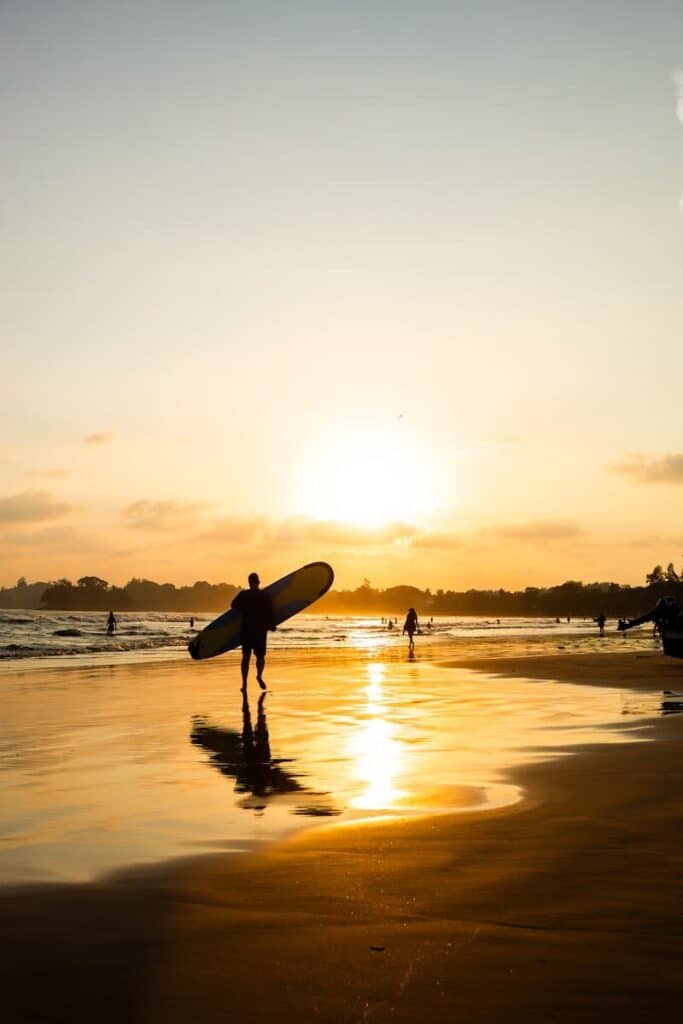
Arugam Bay sits at the southern end of the east coast and occupies a special place in the Sri Lankan surf world. The main point break is one of the most consistent right-handers in Asia, working best between June and September. Around it cluster a series of satellite breaks with evocative names — Whiskey Point, Peanut Farm, Crocodile Rock — that cater to different levels and moods.
The town itself is small, low-key, and genuinely charming in a ramshackle way. There’s a campfire atmosphere after dark, an international crowd of surfers and backpackers, and very little of the resort development that’s reshaped the south coast. Wildlife enthusiasts can combine a stay here with day trips to Kumana National Park, one of Sri Lanka’s least-visited safari destinations.
Where to stay in Arugam Bay: Jetwing Kottukal Beach House — Booking.com 8.6 | $270/night | The most polished stay in the area, close to the main surf break. Aqua Blue Arugam Bay — A more affordable option with good access to the beach.
For surf lessons: Surf Lessons Arugam Bay
Practical Information
Getting Between the Coasts
The south coast train from Colombo runs as far as Matara — stopping at Hikkaduwa, Galle, and a handful of towns along the way. It’s one of the nicest rail journeys on the island and a genuine travel experience rather than just transport. You can book train tickets through 12Go.
Beyond Matara, tuk-tuks and taxis take over. Hiriketiya, Dickwella, Tangalle, and Hambantota are all tuk-tuk territory from Matara station.
Getting to the east coast from the south requires a longer overland journey — typically 4–5 hours by taxi or private driver. There’s no direct coastal train connection between Matara and Trincomalee. A private driver is worth considering for this kind of cross-island transfer. We’ve used Sri Lanka Personal Tour Drivers and can highly recommend them — they’ll handle the logistics and know all the shortcuts.
When to Book
The south coast gets busy between mid-December and mid-January (Christmas/New Year) and again in February. Book accommodation at least two to three months ahead for this window. The east coast has fewer capacity issues, but Arugam Bay in July and August can be surprisingly full.
Best Time to Visit
For a full overview of Sri Lanka’s weather patterns broken down by month, our Sri Lanka weather guide covers everything from average temperatures to monsoon timings. If you’re travelling in a specific month, you’ll find detailed forecasts in our month-by-month weather series.
Final Thoughts on the Best Beaches in Sri Lanka
Sri Lanka rewards the traveller who goes in with their timing sorted and their expectations calibrated. It isn’t the Maldives — the beaches are wilder, the currents less predictable, the infrastructure more variable. But that’s part of the appeal. The south coast, in particular, delivers an experience that’s hard to replicate elsewhere: the sea turtle encounter at dawn at Wijaya Beach, the blue whale season off Mirissa, the horseshoe bay at Hiriketiya in the early morning before the crowds arrive.
The best beaches in Sri Lanka aren’t necessarily the ones with the most sun beds and cocktail menus. Some of the most memorable moments happen on the emptiest stretches — a beach walk at Tangalle with nothing but palms and ocean in view, or an Arugam Bay evening when the surfers have come in and the fire is being lit.
Whatever your style, the south coast is where most travellers start — and end up staying longer than planned. If you get the chance to add the east coast on a return trip, do it. But for a first visit, the south coast gives you everything Sri Lanka’s beaches are about.
Whatever your style, pick your coast, match it to your season, and give yourself more time than you think you’ll need. Sri Lanka has a way of making that easy.
🐘 Plan Your Sri Lanka Trip
🏨 Still looking for the right stay? Browse all hotels in Sri Lanka — free cancellation on most rooms.
✈️ Flights: Compare routes and prices for flights to Sri Lanka.
🚂 Getting around: Book train tickets in advance (the scenic routes sell out), or arrange a private driver, tuk tuk rental or rental car.
📱 Stay connected: Get a Sri Lanka eSIM from Airalo before you fly. We use Airalo ourselves on every trip.
🔒 Travel insurance: Don't skip travel insurance for Sri Lanka — medical costs for tourists add up fast.
🎟️ Tours & activities: Browse safaris, cooking classes and tours across Sri Lanka.
💳 Money: Avoid card fees abroad with a free Revolut account.
Some links on this page are affiliate links. Booking through them costs you nothing extra and helps us keep this site running — thank you!
Frequently Asked Questions
Which coast has the best beaches in Sri Lanka?
The south coast is where the vast majority of travellers spend their beach time in Sri Lanka — and for good reason. It’s more developed, more varied, and more beautiful in the classic tropical sense. The east coast has its own appeal: longer, emptier beaches and a quieter atmosphere, best between May and October. If you can only do one, the south coast is the clear winner for most travellers. The east coast is worth it as a standalone trip or a second visit, especially if you’re into surfing or want somewhere genuinely off the tourist trail.
What is the best beach in Sri Lanka for swimming?
For calm, safe swimming, Passikudah on the east coast and Dalawella/Wijaya Beach on the south coast are the standouts. Both are reef-protected, meaning the water stays genuinely gentle even when swells are bigger offshore. Unawatuna bay is also good for swimming thanks to its offshore reef, though it can get rough closer to the main beach during bigger swell periods. Many of the south coast’s dramatic beaches — Tangalle, Talalla — look stunning but have strong currents and aren’t safe for casual swimmers. On the east coast, Uga Bay Passikudah sits on one of the calmest swimming beaches.
Is Arugam Bay worth visiting if I don’t surf?
Yes — but with realistic expectations. Arugam Bay has a genuinely appealing atmosphere: laid-back, international, campfire-friendly, and surrounded by interesting wildlife areas. The beaches themselves are pleasant, and nearby Kumana National Park makes for a worthwhile safari. That said, the town is small and facilities are limited by south coast standards. If you’re coming purely for beach lounging and good restaurants, the south coast gives you more to work with.
Which Sri Lanka beach is best for families?
Dalawella/Wijaya Beach near Unawatuna is a strong choice — calm lagoon, sea turtles, and a good spread of family-friendly restaurants close by. Passikudah on the east coast is arguably even better for young children, with shallow, almost wave-free water and a handful of well-run resort hotels. Weligama is good for families with older children who want to try surfing. Avoid Tangalle and Arugam Bay with very young children — the sea conditions at Tangalle can be dangerous, and Arugam Bay’s infrastructure is limited. Near Unawatuna, Rockside Cabanas is an easy family base by Wijaya Beach.
Can you visit Sri Lanka beaches year-round?
Yes — and the season rules are more flexible than most guides suggest. The south coast is officially best from November to April and the east coast from May to early October, but the monsoon doesn’t always follow the calendar. Many travellers visit the south coast during the rainy season and have perfectly sunny days, particularly in the shoulder months (October, May). Check forecasts close to your trip and keep some flexibility. If you happen to be there during a wet spell, Sri Lanka’s interior — the hill country, cultural triangle, wildlife parks — is largely unaffected by coastal weather.
How rough are the seas at Sri Lanka beaches?
It varies significantly. Some beaches — Unawatuna, Wijaya, Weligama, Passikudah — have protected bays or reefs that keep conditions gentle most of the year (during their respective dry seasons). Others — Tangalle, the main Arugam Bay beach in off-season, parts of the south coast in May–September — have powerful surf and dangerous currents that make swimming inadvisable. Always ask locally before entering the sea at an unfamiliar beach. Flags and warning signs are not consistently used in Sri Lanka.
What is the best beach in Sri Lanka for surfing?
Arugam Bay is Sri Lanka’s most celebrated surf destination, with a world-class right-hand point break and a string of satellite breaks for all levels. On the south coast, Hiriketiya is the pick for intermediate surfers, Weligama for beginners, and Ahangama/Kabalana for those after reef breaks with more power. Each destination has a peak season: the south coast works November through April, Arugam Bay from May to September. In Arugam Bay, Jetwing Kottukal Beach House is well placed for the surf.
Should I visit Mirissa for whale watching?
If blue whales are on your bucket list, Mirissa between November and April gives you one of the best chances anywhere in the world of seeing them. The bay’s position on the southern tip of the island means boats can reach deep water quickly. Sightings are not guaranteed — the ocean doesn’t work on a schedule — but the operator community in Mirissa is well-established and boats go out daily during the season. Book an early morning tour and allow at least half a day.
Related Blogs
Other Beach Blogs
Best Beach Hotels in Sri Lanka: South Coast vs East Coast
Best Hotels in Galle: From the Fort to the Coast — All Budgets
Sri Lanka South Coast: Beaches, Surf Towns & Coastal Travel
Sri Lanka East Coast: Best Beaches, Bases & When to Go
Unawatuna: Sri Lanka’s Tropical Paradise Known for Pristine Beaches and Vibrant Marine Life
Galle Sri Lanka: Explore the Historic Fort City’s Colonial Heritage and Coastal Vibes
Other Sri Lanka Blogs
Sri Lanka Regions Explained: How to Choose the Best Areas for Your Trip
Best Cities to Visit in Sri Lanka: A Practical Guide to Regions, Routes & City Bases
Sri Lanka Travel Itinerary: Custom Plans for Beach Lovers, City Explorers, and Wildlife Adventurers
Top Things to Do in Sri Lanka: The Most Rewarding Experiences on the Island
Best Time to Visit Sri Lanka: Weather, Seasons & Travel Tips
Sri Lanka Weather by Month: What to Expect Each Season as a Traveller
Getting Around Sri Lanka: Ultimate Guide to Transport, Trains, Tuk-Tuks & Easy Trip Planning
Is Sri Lanka Expensive to Travel? Budget, Costs & Money-Saving Tips for Your Trip
Sri Lanka Travel Guide: Visa Requirements, Vaccination & Local Travel Tips