Table of Contents
Sunlight filtering through clear blue water. Coral gardens glowing in soft colours. A manta ray circling slowly above a cleaning station while reef fish move in shimmering clouds below. This is the image many travellers associate with Maldives diving — calm, warm, and full of life.
Yet the reality of diving in the Maldives is shaped by subtle differences between atolls, seasons, and dive styles. A sheltered house reef can feel worlds apart from a fast-moving channel where sharks and pelagic fish ride the currents.
Understanding those differences is what turns a good dive trip into an unforgettable one. This guide looks beyond postcard imagery to explore how Maldives diving actually works — from choosing the right regions and seasons to knowing what marine life you are most likely to encounter beneath the surface.
In a Rush?
These are my Favourite Diving Hotels
- ⭐️⭐️⭐️ LUX South Ari Atoll – Resort – Check out Prices & availability
- ⭐️⭐️Boutique Beach All Inclusive Diving Hotel – Dhigurah – Check out Prices & availability
- ⭐️ White Sand –Dhigurah – Check out Prices & availability
Maldives Diving at a Glance
Not all diving experiences in the Maldives are the same. Conditions, marine life, and suitability vary depending on season, atoll, and experience level.
This quick overview highlights the most important decision points for planning a Maldives diving trip — helping you see at a glance what works best for your goals before diving deeper into the detailed sections below.
| Focus | Best choice | What to expect | Good to know |
|---|---|---|---|
| First-time diving | House reefs, North Ari | Calm conditions, shallow sites | Avoid channel dives |
| Big marine life | South Ari, Baa (seasonal) | Whale sharks, manta rays | Sightings depend on season |
| Variety & balance | North Ari | Mix of reefs & channels | Some sites need experience |
| Advanced diving | Vaavu, Fuvahmulah | Strong currents, sharks | Not beginner-friendly |
| Best visibility | Dec-Apr (dry season) | Clear water, calmer seas | Fewer mantas in some areas |
| Best value | Liveaboards | 3-4 dives per day | Fixed itineraries |
If you're already planning to dive during your Maldives trip, you can browse some of the most popular diving experiences across the islands below.
Best Time for Maldives Diving: Seasons, Visibility & Marine Life
Diving in the Maldives is possible year-round, but conditions change noticeably with the monsoon seasons. There is no single universal “best” time to dive — instead, the best period depends on what you want to see, your experience level, and which atoll you choose.
The Maldives lies along plankton-rich ocean currents. As these currents shift during the year, marine life such as manta rays and whale sharks move between atolls.
Dry Season (December – April)
The dry season is often considered the easiest and most comfortable time for Maldives diving, especially for first-time divers.
What to expect:
- Clear blue water with visibility often between 20–30 metres
- Calmer seas and more predictable conditions
- Excellent underwater light for photography
Best suited for:
- Beginner divers
- Relaxed drift dives and house-reef diving
- Travellers combining diving with snorkelling or family travel
Western atolls such as North Ari, South Ari, and Baa generally offer the best conditions during this period.
Wet Season (May – November)
The wet season brings higher plankton concentrations into the water. While this can slightly reduce visibility, it also triggers some of the Maldives’ most spectacular marine-life events.
What to expect:
- Visibility can drop, especially during plankton blooms
- Stronger currents in channels
- Increased pelagic activity
Best suited for:
- Divers focused on manta rays and large marine life
- Experienced divers who are comfortable with currents
- Liveaboard itineraries following seasonal hotspots
Eastern atolls and specific feeding areas shine during this season, with manta rays gathering in large numbers.
Marine Life Calendar: What You Can See and When
If your Maldives diving trip is centred around a specific species, timing and location matter more than overall visibility. The calendar below helps match marine life to the right atoll and season.
| Marine Life | Best Atoll(s) | Best Time | Notes |
|---|---|---|---|
| Whale sharks | South Ari | Year-round (strongest Apr-Dec) | Only reliable year-round hotspot |
| Manta rays | Baa (Hanifaru Bay) | May-Nov (peak Jul-Oct) | Snorkelling only inside the bay |
| Manta rays | North Male (Lankan Manta Point) | Dec-Mar | Cleaning station, suitable for divers |
| Reef sharks | Ari, Vaavu, Laamu | Year-round | Often seen on channel and thila dives |
| Tiger sharks | Fuvahmulah | Year-round | Advanced divers only |
Why this matters: planning around marine life behaviour helps avoid disappointment and ensures your itinerary matches your expectations.
Key Takeaway
Marine life in the Maldives doesn’t disappear with the seasons — it moves. Choosing the right atoll for the right time of year is far more important than chasing a specific month on the calendar.
If you want to know more about what's the best time to visit the Maldives, read our full guide Best Time to Go to Maldives: Weather, Climate & Seasonal Tips for Your Perfect Island Vacation.

The Top Dive Sites and Atolls for First-Timers
The Maldives is made up of dozens of atolls, but not all offer the same diving experience. Conditions, marine life, and suitability vary widely depending on currents, reef structure, and proximity to channels. Below are the atolls most relevant for travellers planning a Maldives diving trip, each with a clearly defined role.
North Ari Atoll – Versatile Diving for Most Experience Levels
North Ari Atoll is one of the most popular regions for Maldives diving because it offers a balanced mix of protected dive sites and more exposed channels.
Why North Ari works well:
- Wide range of dive sites, from sheltered thilas to open channels
- Good year-round marine life
- Suitable for beginners and advanced divers, depending on the site
What you can expect underwater:
- Thilas covered in soft corals and schooling fish
- Regular sightings of turtles, whitetip reef sharks, and grey reef sharks
- Seasonal pelagics in channels
Notable dive sites:
- Maaya Thila: a sheltered pinnacle ideal for newer divers and night dives
- Rasdhoo Channel: known for hammerhead sightings, suitable only for experienced divers due to depth and currents
Trade-off: while North Ari offers variety, some of its most famous dives (like hammerheads) require early starts, depth, and strong-current experience.
Several dive centres operate daily trips to the famous thilas and channels of North Ari Atoll.
Klook.com
South Ari Atoll – Best for Whale Sharks
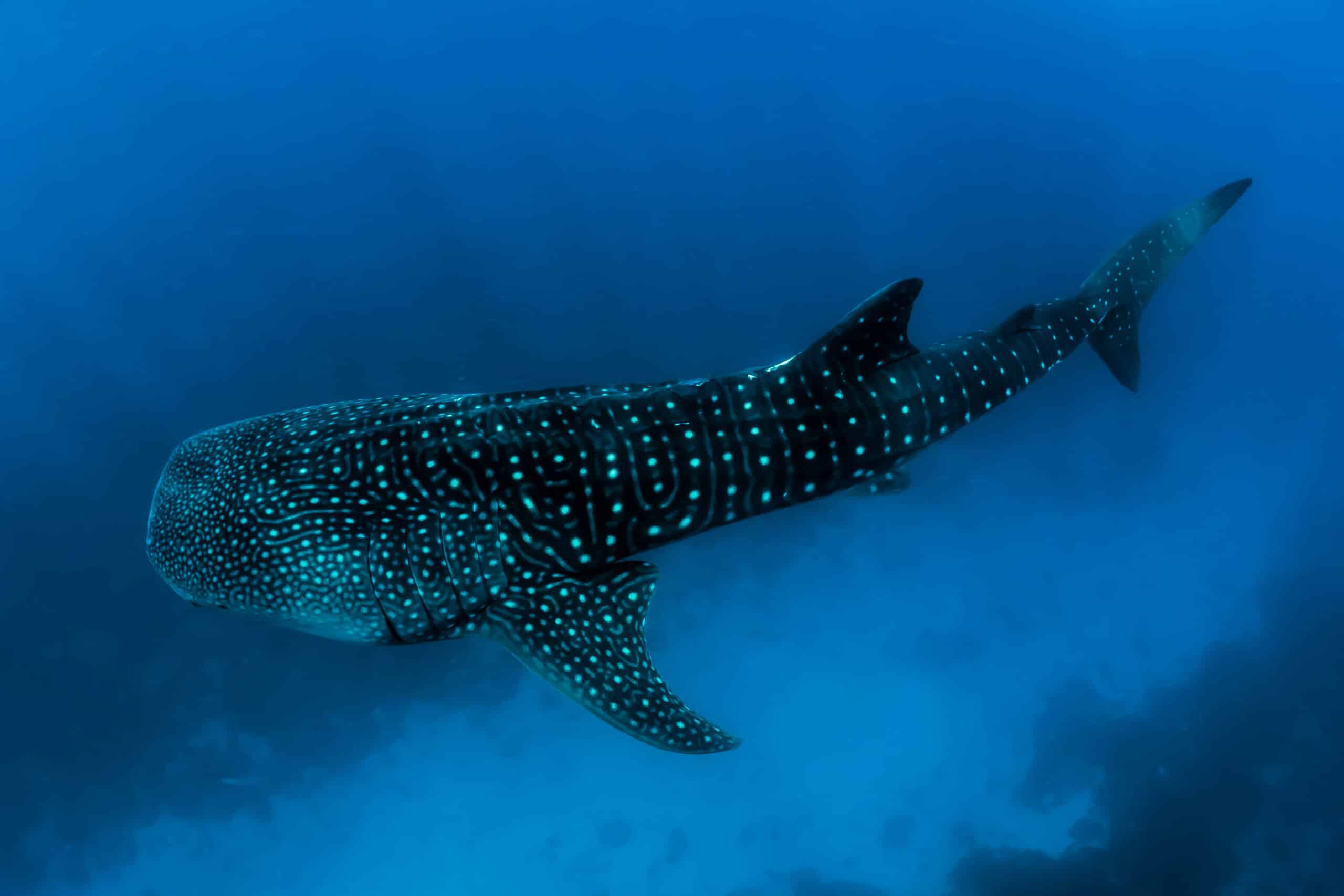
South Ari Atoll is the most reliable place in the Maldives to encounter whale sharks and is a key destination for travellers prioritising big-animal encounters.
Why South Ari stands out:
- Only atoll with consistent, year-round whale shark sightings
- Easy to combine diving and snorkelling
- Suitable for mixed-ability groups
What you can expect underwater:
- Whale sharks frequently spotted near the surface, especially around Dhigurah and Maamigili
- Reef sharks, turtles, and healthy coral gardens
- Gentle drift dives suitable for intermediate divers
Limitations to consider:
- Popular areas can feel busy during peak season
- Whale shark encounters often happen while snorkelling rather than during deep dives
South Ari Atoll is one of the best regions for whale shark encounters and relaxed drift dives.
Baa Atoll – Seasonal Manta Ray Capital
Baa Atoll is globally recognised for its manta ray aggregations and protected marine environment.
Why Baa Atoll is unique:
- UNESCO Biosphere Reserve
- Hosts one of the world’s largest seasonal manta ray feeding events
What you can expect underwater:
- Manta rays gathering in large numbers during plankton blooms
- Healthy coral reefs and strong reef-fish populations
Important restriction:
- Hanifaru Bay itself is snorkelling only — scuba diving is not permitted to protect the ecosystem
Best for: travellers visiting between May and November who want to combine manta snorkelling with nearby reef dives.
Outside Hanifaru Bay, islands such as Dharavandhoo serve as a base for diving and snorkelling trips to nearby reefs during manta season.
Divers staying in Baa Atoll can join guided reef dives and seasonal manta excursions from islands such as Dharavandhoo.
Klook.comVaavu Atoll – Channel Diving & Shark Encounters
Vaavu Atoll is known for its deep channels and stronger currents, making it a favourite among more experienced divers.
Why divers choose Vaavu:
- Strong currents attract sharks and large schools of fish
- Famous night dives with nurse sharks
What you can expect underwater:
- Grey reef sharks, whitetip reef sharks, and nurse sharks
- Dense schools of snappers and jacks in channels
Trade-off: conditions can be challenging for beginners, and many dives are drift or channel-based.
Vaavu Atoll is known for drift dives and shark encounters, including famous nurse shark night dives.
Fuvahmulah – Advanced Shark Diving
Fuvahmulah, located in the far south of the Maldives, offers a completely different diving experience.
Why Fuvahmulah is special:
- One of the most reliable tiger shark diving locations in the world
- Unique pelagic encounters not commonly seen elsewhere in the Maldives
What you can expect underwater:
- Tiger sharks on almost every dive
- Possibility of thresher sharks, hammerheads, and oceanic species
Who this is for: experienced divers only. Depth, open-ocean conditions, and strong currents make this unsuitable for beginners.
Experienced divers can join specialised shark dives around Fuvahmulah, one of the world’s most reliable tiger shark destinations.
House Reefs – Ideal for Beginners and Easy Diving
House reefs are the easiest and most accessible way to experience Maldives diving, especially for first-timers.
Why house reefs work well:
- Shallow depth and calm conditions
- Direct access from resorts and local islands
- Ideal for Discover Scuba Diving and relaxed dives
What you can expect underwater:
- Reef fish, turtles, stingrays, and occasional reef sharks
- Excellent conditions for skill practice and underwater photography
Trade-off: limited access to large pelagics compared to channel and offshore dives.
Getting Started: Maldives Diving for Beginners
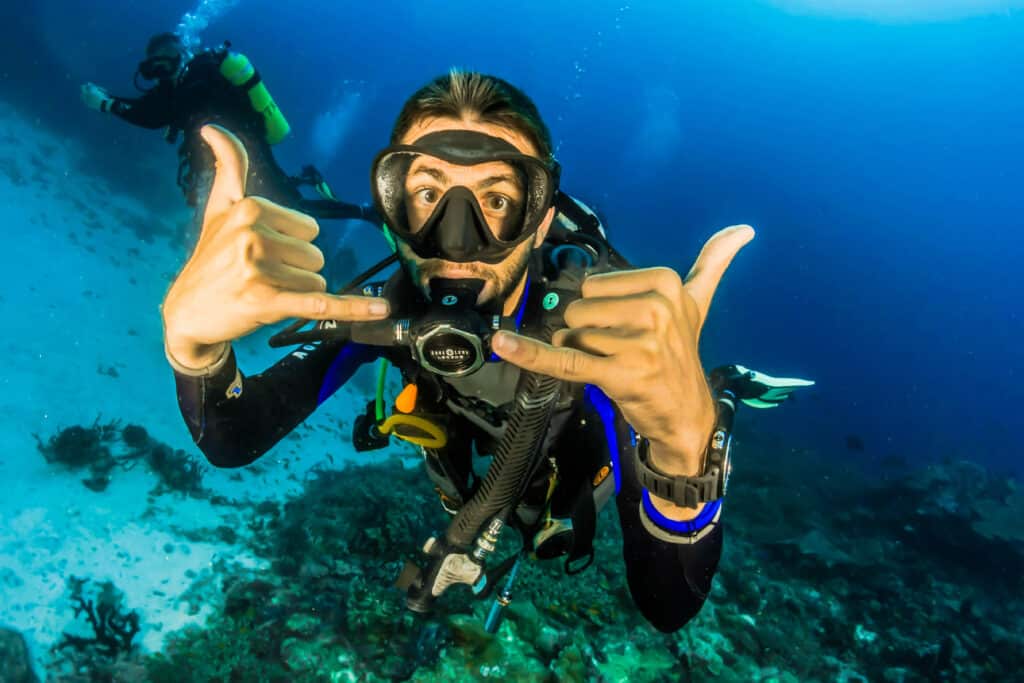
The Maldives is widely regarded as one of the easiest and most comfortable places in the world to try scuba diving for the first time. Warm water, excellent visibility, and a large number of sheltered lagoons lower many of the barriers that beginners face in colder or more technical dive destinations.
That said, not every dive site in the Maldives is beginner-friendly. Strong currents, deep channels, and drift dives are common in certain atolls, which is why understanding where and how beginners dive here is essential.
Discover Scuba Diving (DSD)
Discover Scuba Diving is designed for travellers who want to experience diving without committing to a full certification course. It is the most common entry point into Maldives diving for first-timers.
What DSD typically includes:
- No prior certification required; basic swimming ability is sufficient
- A short theory briefing covering breathing, pressure equalisation, and hand signals
- Confined-water practice in a lagoon or pool
- One guided open-water dive, usually limited to a maximum depth of 12 metres
In the Maldives, DSD dives almost always take place on protected house reefs or shallow lagoon sites, where currents are minimal and conditions are calm. This makes the experience feel relaxed rather than overwhelming.
Who DSD is best for:
- Complete beginners
- Travellers short on time
- Anyone unsure whether they want to pursue full certification
Limitations: DSD dives are shallow and site-restricted, meaning you will not access channels, deeper reefs, or cleaning stations where larger pelagics gather.
Travellers staying on local islands often try their first dive through beginner-friendly programmes. On islands like Maafushi, Discover Scuba Diving is widely available and focuses on calm, shallow sites ideal for first-time divers.

Getting Certified: PADI Open Water in the Maldives
For travellers who want more independence underwater, completing an Open Water certification in the Maldives is a popular choice.
Why the Maldives works well for certification:
- Warm water eliminates the need for thick wetsuits
- High visibility reduces stress during skills practice
- Calm house reefs allow skills to be mastered gradually
What to expect:
- Course duration of 3–4 days
- Combination of theory, confined-water skills, and open-water dives
- Maximum certified depth of 18 metres upon completion
Many new divers appreciate that their first certified dives happen in environments with turtles, reef sharks, and healthy coral — rather than murky training quarries or cold lakes.
Choosing Beginner-Friendly Dive Locations
Not all Maldivian atolls are equally suitable for beginners. The best beginner locations share three characteristics: shallow reefs, limited current exposure, and easy boat access.
Generally beginner-friendly options include:
- House reefs at resorts and local islands
- Sheltered thilas in North Ari Atoll
- Lagoon-based dive sites with minimal current
Less suitable for beginners:
- Channel dives in Vaavu Atoll
- Deep or current-exposed sites such as Rasdhoo Channel
- Open-ocean dives in Fuvahmulah
Key Takeaway for Beginners
The Maldives is beginner-friendly by design, but only if dives are matched to experience level. Staying on house reefs, choosing sheltered sites, and diving with experienced guides allows first-time divers to enjoy the Maldives safely and confidently — without being pushed into conditions better suited to advanced divers.
What Marine Life Can You See While Diving in the Maldives?
The diving experience in the Maldives is not defined by a single species or rare sighting, but by the overall experience underwater. On most dives, you can expect a combination of active reef life, passing sharks, and moments where larger animals appear unexpectedly.
This section looks at the marine life divers commonly encounter during a typical Maldives dive — from everyday reef scenes to the encounters that make this destination so memorable.
Quick Overview: Where to See What
Below is a simple overview of the marine life divers most commonly encounter in the Maldives, and where sightings are generally most likely. This overview helps give a clear, at-a-glance impression of where different marine species are most commonly encountered while diving in the Maldives.
| Marine Life | Where it-s commonly seen | What to expect |
|---|---|---|
| Whale sharks | South Ari (most reliable) | Often near the surface, calm, slow encounters |
| Manta rays | Baa, Ari, North Male, Addu | Seasonal and location-dependent cleaning and feeding behaviour |
| Reef sharks | Ari, Vaavu, Laamu | Very common on thilas and channel dives |
| Nurse sharks | Vaavu, Raa, South Ari | Often resting, famous night dives in Vaavu |
| Tiger sharks | Fuvahmulah | Advanced diving only, highly reliable sightings |
| Sea turtles | Ari, Lhaviyani, Raa | Regular encounters on healthy reefs |
| Eagle & stingrays | Raa, Noonu, Addu | Frequently seen along sandy bottoms and reef edges |
Reef Sharks: A Constant Presence
Sharks are one of the defining features of Maldives diving. Unlike destinations where sightings are occasional, reef sharks are commonly encountered on many dives.
- Whitetip reef sharks are frequently seen resting on sandy bottoms or cruising around thilas
- Blacktip reef sharks often appear in shallow lagoons and near reef edges
- Grey reef sharks are typically found in channels with stronger currents
In addition to reef sharks, the Maldives is also known for encounters with nurse sharks and, in very specific locations, tiger sharks. These species are discussed separately below, as they occur in more location-specific conditions and are not part of most everyday dives.
For many divers, seeing sharks here quickly becomes normal rather than exceptional.

Rays: Mantas and Beyond
While manta rays are the headline species, they are not the only rays divers encounter.
- Manta rays gather at cleaning stations and feeding sites, depending on season and atoll
- Eagle rays often glide along outer reef walls
- Mobula rays are occasionally seen in deeper or offshore water
Manta encounters are seasonal and location-specific, which is why timing is covered in the calendar rather than repeated here.
Want to know more about swimming with manta rays, read the full guide: Manta Rays in Maldives: Best Places, Season & Ethical Snorkelling Guide.
Whale Sharks: Rare but Unforgettable
Whale sharks are the largest fish in the ocean and one of the Maldives’ biggest draws.
- Most encounters occur in South Ari Atoll
- Sightings often happen near the surface rather than on deep dives
- Encounters are typically calm and slow-moving
Even a single sighting often becomes the highlight of a trip.
Read all about swimming with whale sharks in this guide: Whale Sharks in Maldives: Best Spots & Tours for Encounters.

Turtles: Reliable and Relaxed Encounters
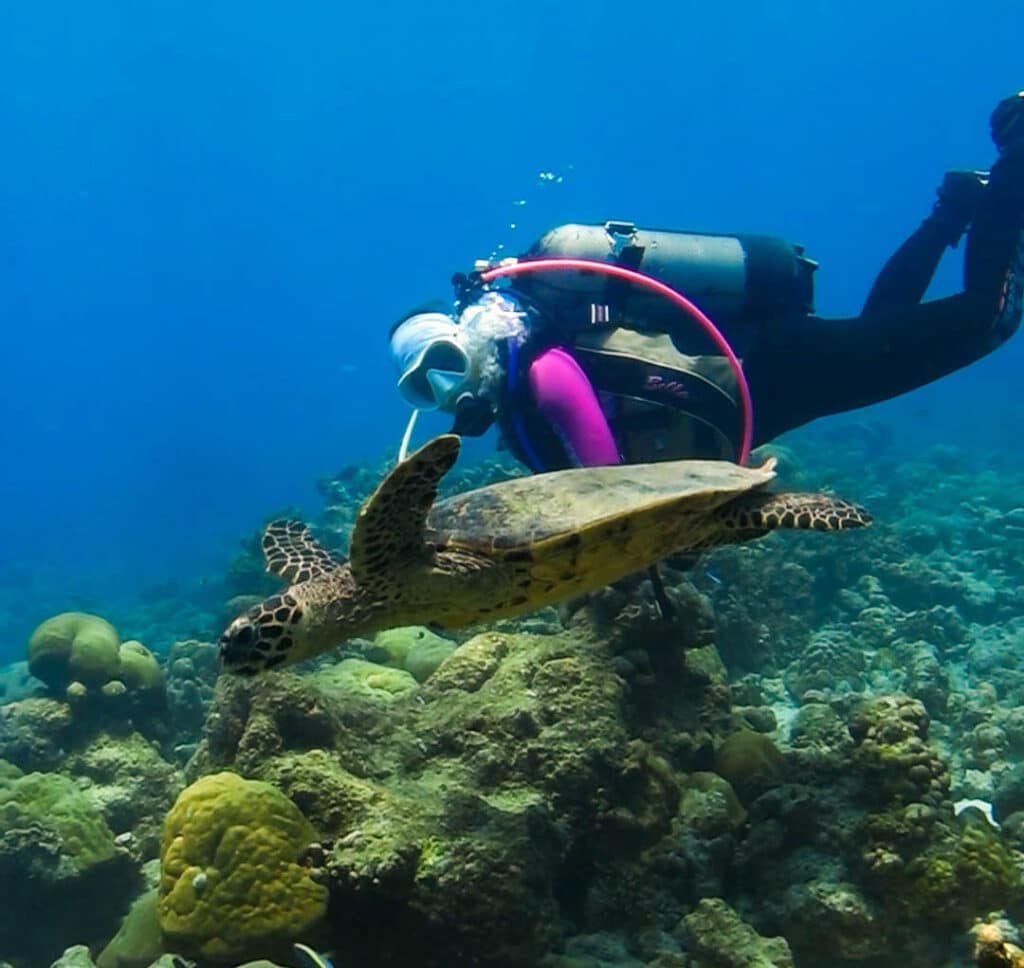
Sea turtles are consistently seen across many Maldivian reefs.
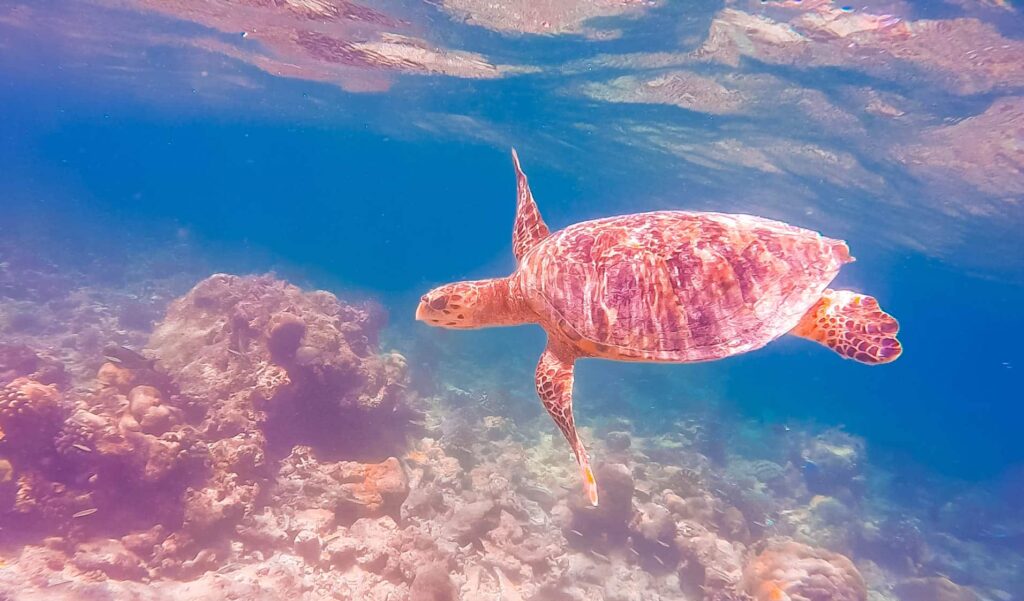
- Hawksbill turtles are common on healthy coral reefs
- Green turtles are often found near seagrass beds and shallow lagoons
Turtles are frequently encountered on both beginner and advanced dive sites.
Want to know all about swimming with sea turtles, read our full guide: Swimming with Sea Turtles in Maldives: Best Spots & Tips.
Reef Fish, Corals & Daily Life on the Reef
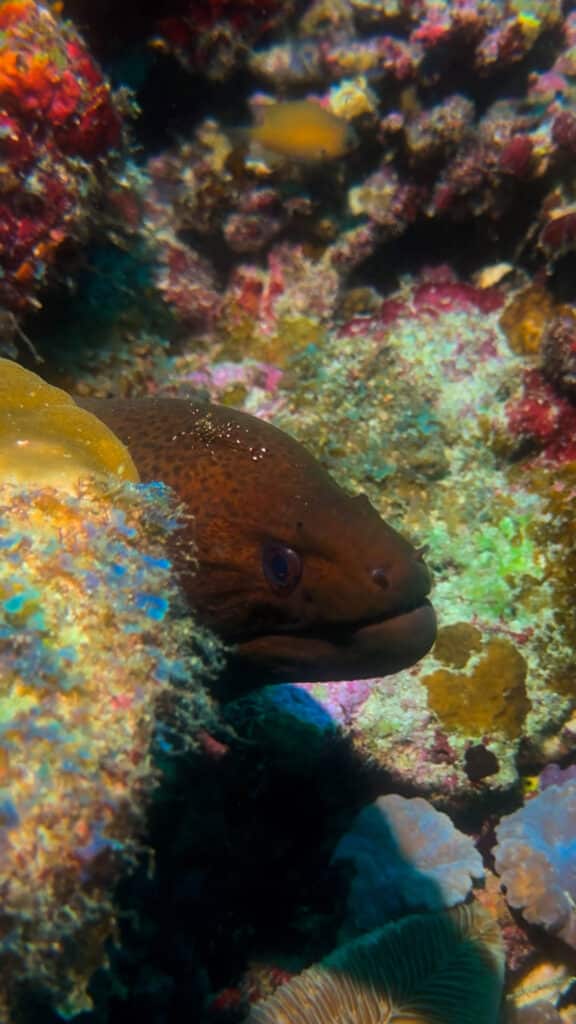
Beyond large animals, Maldivian reefs are characterised by constant movement and colour.
You can expect to see:
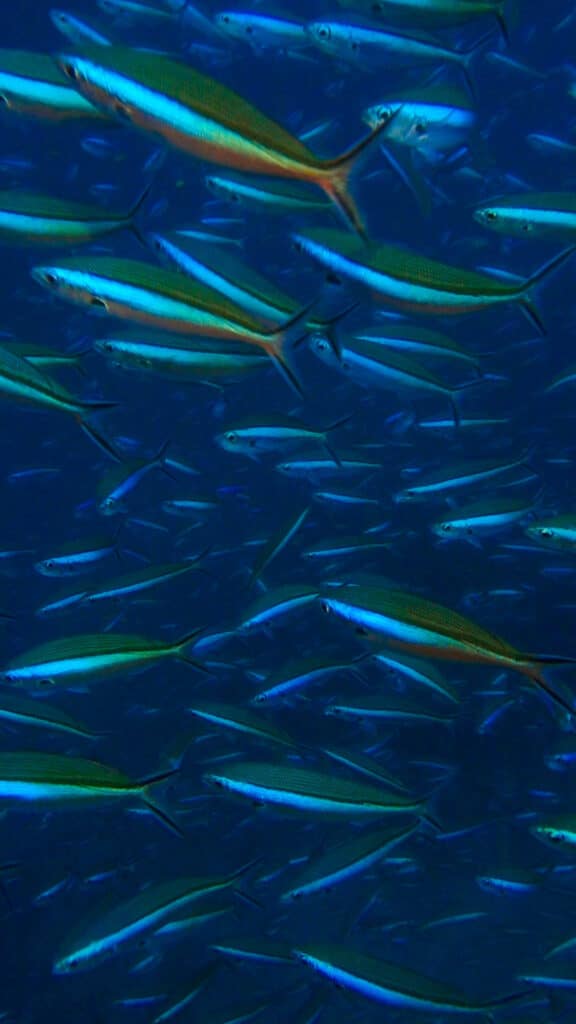
- Large schools of fusiliers and snappers
- Clouds of anthias around coral heads
- Butterflyfish, angelfish, and parrotfish across most reefs

Important Trade-Off to Understand
The most spectacular encounters with sharks and rays often happen in channels and current-exposed sites. These dives are exhilarating but may not be suitable for everyone.
Divers who prefer calm conditions will still see plenty of marine life on house reefs and sheltered thilas — just with fewer large pelagics.
Diving vs. Snorkelling in the Maldives: What’s the Difference?
The Maldives is one of the few destinations where both snorkelling and diving offer genuinely impressive marine encounters. Many travellers wonder whether scuba diving is really necessary here, or if snorkelling alone is enough.
The answer depends on how deep you want to go — literally and figuratively.
Depth & Access
Snorkelling takes place at the surface, usually above shallow house reefs and lagoons (roughly 1–5 metres). It offers easy access to colourful coral gardens and plenty of marine life without any training.
Diving allows you to explore deeper environments (10–30+ metres), including thilas, reef walls, and channels where currents concentrate larger animals.
Marine Life: What You’re Likely to See
Snorkelling highlights:
- Blacktip reef sharks, often close to shore
- Sea turtles feeding on shallow reefs or seagrass beds
- Stingrays resting on sandy bottoms
- Manta rays at the surface in places like Hanifaru Bay
- Dense reef fish and healthy coral gardens
Diving highlights:
- Whitetip and grey reef sharks in channels and around thilas
- Nurse sharks, especially on night dives in Vaavu Atoll
- Manta rays at cleaning stations below the surface
- Large schools of fish in current-exposed sites
- Occasional whale shark encounters, depending on location

Experience Level & Accessibility
Snorkelling is accessible to almost everyone, including children and non-swimmers with flotation support.
Diving requires either a Discover Scuba Diving experience or certification. Some dive sites involve currents and drift dives, which are better suited to confident or experienced divers.
Safety & Conditions
Snorkelling usually takes place in calm lagoons and along shallow house reefs, where currents are minimal and conditions are predictable.
Diving exposes you to deeper water, drift dives, and channels where currents can be stronger. These conditions are part of what makes Maldives diving exciting, but they also require good briefing, buoyancy control, and attention to your surroundings.
Cost Difference
- Snorkelling trips: often $25–50 per excursion, and frequently included in resort or guesthouse stays
- Diving: typically $60–85 per single dive, or lower per dive when booked as part of a package
Which One Should You Choose?
Choose snorkelling if you want an easy, relaxing way to enjoy colourful reefs, turtles, rays, and regular marine life with minimal preparation.
Choose diving if you want access to deeper reefs, manta cleaning stations, sharks in channels, and the full richness of Maldivian underwater ecosystems.
Many visitors choose a combination: snorkelling around the house reef and diving for the most memorable encounters.
Maldives Diving Cost: Budgeting for Your Trip
Understanding the cost of diving in the Maldives helps you decide not just how much you’ll spend, but which diving style offers the best value for your travel plans. Prices vary depending on whether you dive from a resort, a local island, or a liveaboard — and how many dives you plan to do.
Typical Diving Costs
As a general guideline, expect the following price ranges:
- Single dive: around $60–85 per dive
- Dive packages: roughly $40–60 per dive when booking 10 or more dives
Packages often include additional value such as free nitrox (where available), equipment discounts, or complimentary shore dives, which can significantly lower the average cost per dive.
Resort Diving vs Local Island Diving
Resort-based diving is usually the most convenient option. Dive centres are on-site, boats depart directly from the jetty, and logistics are seamless.
- Pros: convenience, high safety standards, easy for beginners
- Cons: higher cost per dive, less flexibility on pricing
Local island diving is often more budget-friendly and appeals to travellers staying in guesthouses.
- Pros: lower prices, access to the same reefs and channels
- Cons: fewer daily departures, longer boat rides to some sites
In terms of underwater experience, there is often little difference between resort and local island diving — the main distinction lies in comfort and logistics rather than marine life.
Liveaboard Diving: Cost vs Value
Liveaboards offer a very different cost structure and are often the best value for dedicated divers.
- Typically include accommodation, meals, and 3–4 dives per day
- Lower cost per dive when diving intensively
- Access to remote sites that are difficult to reach from land
Trade-off: liveaboards follow a fixed itinerary and schedule, which offers less flexibility for non-divers or mixed-activity trips.
Liveaboards are especially attractive for divers who want to maximise underwater time or plan their trip around seasonal hotspots.
For travellers considering a liveaboard experience, operators such as Maldive Dreamers focus on small-group itineraries that follow seasonal marine-life patterns across different atolls. Readers of Sri Lanka & Maldives can currently use the code Maartje103 to receive $100 off their booking.
Here you can read the full blog about Liveaboard Maldive Dreamers.

Crucial Safety & Logistics Tips – Understanding Currents
Understanding Currents & Drift Diving
Drift diving is a defining feature of diving in the Maldives. Many dives take place in channels where currents bring nutrients — and with them sharks, rays, and large schools of fish.
- Dive guides assess current strength and direction before every dive
- Divers are briefed on entry, descent, and exit procedures
- Boats follow divers during drift dives for controlled pick-ups
While drift diving is often relaxed and effortless, stronger currents are best suited to confident or experienced divers.
Territorial Marine Life to Be Aware Of
While sharks often receive the most attention, one of the few animals divers actively need to be cautious around in the Maldives is the titan triggerfish.
This species is highly territorial, particularly during nesting season, and may charge or bite if divers enter its breeding area. Although relatively small, titan triggerfish are fast and persistent when defending their nests.
Dive guides are familiar with this behaviour and will usually signal or redirect divers if a triggerfish is present. Staying aware of your surroundings and following your guide’s instructions is typically enough to avoid any issues.
Dive Insurance & No-Fly Time
- Dive insurance (such as DAN) is strongly recommended, especially for deeper or current-exposed dives
- Respect a minimum 18–24 hour no-fly time after multiple dives
Who this is not for: travellers uncomfortable with open-water conditions or currents should stick to lagoon and house-reef dives.
Understanding these basics is the foundation of a safe and enjoyable dive trip. Knowing when to go, where to dive, and what to expect underwater helps you plan a Maldives diving experience that matches your comfort level, interests, and experience.

Final Thoughts on Diving in Maldives
Maldives diving rewards travellers who approach it with curiosity rather than fixed expectations. Some days unfold slowly along calm house reefs filled with turtles and reef fish, while others carry divers through channels where sharks circle in the blue.
The real magic lies in that contrast. Across the archipelago, each atoll reveals a slightly different underwater world shaped by currents, seasonality, and reef structure.
For travellers planning a trip around the ocean — whether as a first dive experience or a journey focused on marine encounters — Maldives diving offers remarkable diversity beneath the surface. From here, the next step is choosing the right islands, seasons, and marine hotspots that best match the kind of underwater experience you are hoping to find.
🌴 Plan Your Maldives Trip
🏨 Still looking for the right stay? Browse all resorts in the Maldives or hotels & guesthouses on local islands — free cancellation on most rooms.
✈️ Flights: Compare routes and prices for flights to the Maldives.
📱 Stay connected: Skip the airport SIM queue — get a Maldives eSIM from Airalo before you fly. We use Airalo ourselves on every trip.
🔒 Travel insurance: Medical help in the Maldives often means evacuation by seaplane — don't skip travel insurance for the Maldives.
🤿 Tours & activities: Browse snorkelling trips, dolphin cruises and excursions across the Maldives, or check liveaboard diving trips.
💳 Money: Avoid card fees abroad with a free Revolut account.
Some links on this page are affiliate links. Booking through them costs you nothing extra and helps us keep this site running — thank you!
Frequently Asked Questions about Maldives Diving
Where can you see whale sharks and manta rays while diving in the Maldives?
South Ari Atoll is the most reliable place to see whale sharks in the Maldives, with sightings possible throughout the year, particularly around Dhigurah and Maamigili. Manta rays are more seasonal and move between different atolls depending on plankton flows. Baa Atoll is famous for manta gatherings between May and November, while cleaning stations in Ari, Raa, Lhaviyani and Addu Atolls also attract mantas at different times of the year.
Is Maldives diving suitable for beginners without certification?
Yes. Many travellers try diving for the first time through a Discover Scuba Diving programme, which allows non-certified beginners to dive under the supervision of a professional instructor. After a short briefing and shallow-water practice, participants complete a guided dive, usually limited to around 12 metres. These dives typically take place on calm house reefs or sheltered lagoon sites where currents are minimal.
Do you need a wetsuit when diving in the Maldives?
Water temperatures in the Maldives usually range between 26°C and 30°C throughout the year, so many divers are comfortable wearing only a swimsuit or rash guard. However, a thin 3 mm wetsuit is often recommended for longer dive days, deeper dives, or multiple dives in one day, as it helps retain body heat and provides some protection against coral and minor scrapes.
Can you see sharks while diving in the Maldives?
Yes, shark encounters are common on many dives in the Maldives. Divers frequently see species such as whitetip reef sharks, blacktip reef sharks, and grey reef sharks, particularly around thilas and channel dives. In certain locations, divers may also encounter nurse sharks or even tiger sharks. These sharks are generally calm and accustomed to divers, making them one of the highlights of Maldives diving.
Is diving in the Maldives safe for travellers?
Diving in the Maldives is considered safe when conducted with licensed dive centres and experienced guides. Operators assess currents before each dive, provide detailed safety briefings, and match dive sites to the group’s experience level. As with any dive destination, divers should follow their guide’s instructions, maintain good buoyancy control, respect no-fly time after diving, and consider specialised dive insurance for added protection.
Related Blogs
Other Maldives Activities
Top Activities in Maldives: Snorkelling, Diving & Swimming with Manta Rays
Manta Rays in Maldives: Best Places, Season & Ethical Snorkelling Guide
Swimming with Sea Turtles in Maldives: Best Spots & Tips
Sandbanks in Maldives: Unmissable Sandbank Adventures & Island Experiences
Whale Sharks in Maldives: Best Spots & Tours for Encounters
Snorkelling in Maldives: Best Places to Go & Marine Life
Liveaboard Diving Trips in Maldives: Explore Top Dive Sites & Underwater Life with Maldive Dreamers
Other Maldives Blogs
How to Choose a Maldives Resort: The Complete Decision Guide
Best Hotels on Local Islands in Maldives (By Budget): Complete Guide for 2026
How to Choose the Best Atoll in Maldives: A Complete Area & Stay Guide
Maldives Vacation: How to Plan Your Dream Island Escape for Adventure and Relaxation
Trip to Maldives: Essential Information on Islands, Visa, Vaccinations & Entry Requirements
Best Time to Go to Maldives: Weather, Climate & Seasonal Tips for Your Perfect Island Vacation
Best Hotel in Maldives Island: Top Luxury, Boutique & Affordable Stays for Every Traveller